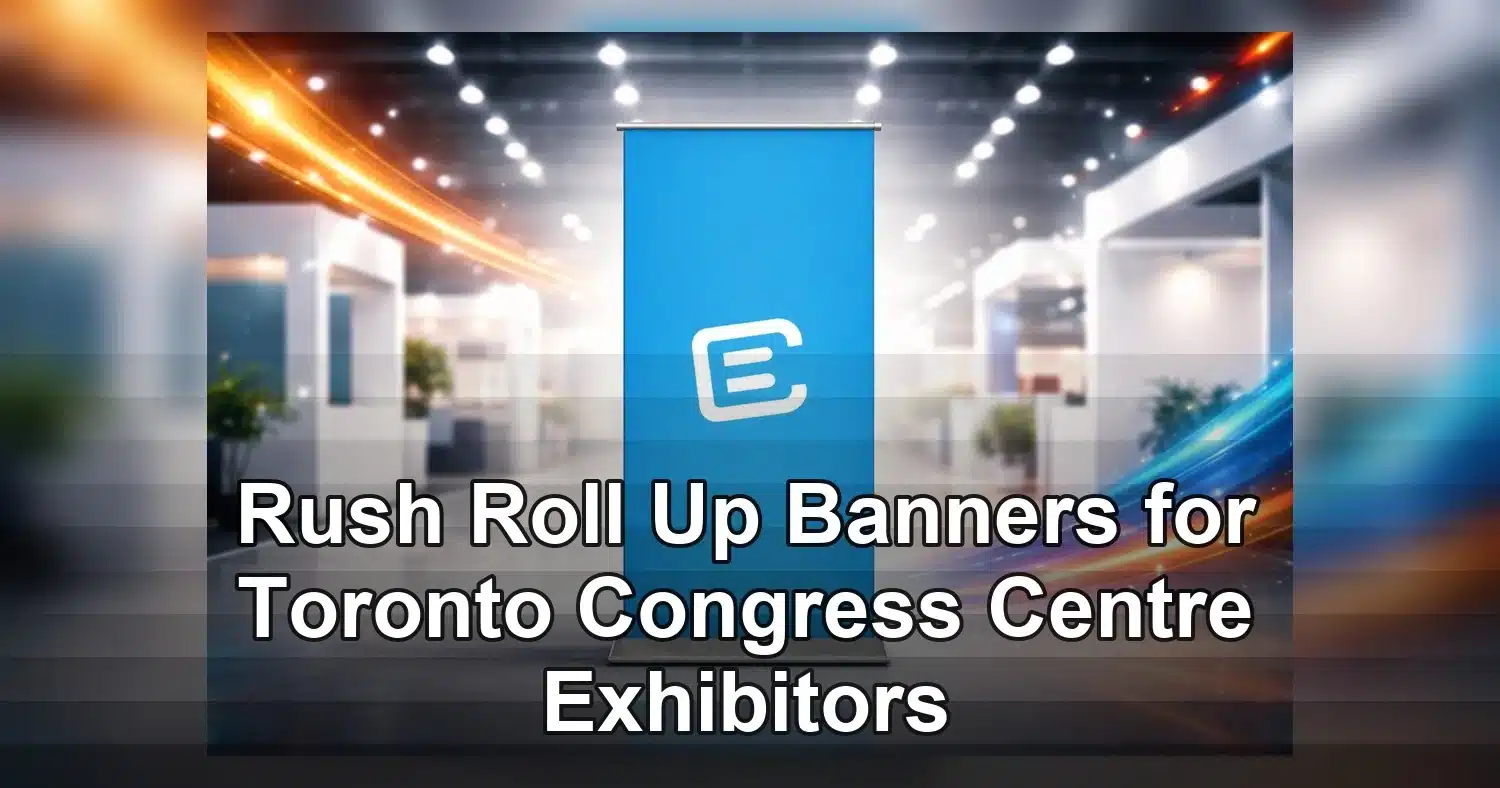
If you need rush roll up banners toronto congress centre for an upcoming show, the fastest path is usually a print-ready file, one approved proof, and local production that can match your move-in schedule. For exhibitors, event marketers, and booth managers, retractable banners are one of the simplest ways to replace missing signage, tighten branding, and create a polished backdrop without waiting on a full display build. They arrive in a compact case, set up in minutes, and work well for booth messaging, wayfinding, sponsor recognition, and QR-based lead capture on a busy show floor.
Last updated: April 2026
Ready to print roll-up banner printing?
Send your artwork, quantity, and deadline to Branding Centres. We will help confirm specs, turnaround, and the best production option.

When the deadline is close, speed depends on the details. Correct size, strong image resolution, stable hardware, and a clear delivery plan all matter at Toronto Congress Centre. If the banner is part of a larger booth refresh, it helps to finalize the artwork early, choose a standard format, and confirm who will approve the proof. That reduces back-and-forth and keeps the order moving through production instead of stalling in revisions.
Why Toronto Congress Centre exhibitors rely on rush roll up banners
Retractable banners are popular because they solve a common event problem: the booth is almost ready, but one key display element is still missing. A roll up banner can fill that gap quickly and still look professional. It creates a branded presence without requiring wall mounts, tools, or a long installation window, which is useful when setup time is compressed.
That matters at Toronto Congress Centre, where exhibitors often need to work around dock timing, labor schedules, and a crowded load-in. A banner can restore a missing product message, cover a blank wall, or add a clear call to action right at the aisle edge. If shipping delays, a damaged panel, or a last-minute sponsor change disrupt the booth plan, a rush banner is often the fastest way to recover the presentation.
Useful booth applications
Roll up banners are especially effective for reception counters, side walls, corner booths, product callouts, media backdrops, and registration areas. They can also support show-only offers, booth directions, speaker promotion, or a simple branded welcome message. Because the display stays upright and compact, it fits well in tight footprints where larger fabricated graphics would be too slow or too bulky.
For teams that need a clean first impression fast, this format is hard to beat. It looks organized, takes up very little floor space, and can be packed away and reused for another event if the message stays relevant.
What to confirm before ordering rush roll up banners
The quickest orders are the ones where the basics are already decided. Before production begins, confirm the display size, artwork format, and hardware style. If those choices are clear, the file can move straight into proofing and print instead of waiting for missing details.
Choose the size first
- 33 x 81 inches: A standard size that works well for most trade show booths and is easy to transport.
- 36 x 81 inches: Slightly wider, with a bit more presence when the banner needs to stand out from the aisle.
- 48 x 81 inches: Better for open booth layouts or when the display has to be seen from farther away.
If the booth is narrow, a smaller banner may be the better fit. If the space is open and traffic is heavy, a wider format can improve visibility. The right answer usually depends on how close the banner will sit to counters, literature racks, or product tables.
Prepare the file for quick output
Rush printing is much easier when the artwork is already built at final size. Use a high-resolution PDF whenever possible, with images that stay sharp at print scale. A good rule is 150 to 300 DPI at final size, depending on the viewing distance. Use CMYK color mode and keep all essential text inside a safe area so nothing important is hidden by the cassette hardware or trimmed off at the edges.
It also helps to place the headline high enough to be read from standing height. QR codes should be large enough to scan from a few feet away, and small contact details should not sit too close to the bottom edge. Those simple choices can save time during proofing and prevent a second round of corrections.
Pick the right material and finish
For rush orders, the banner graphic is usually printed on a curl-resistant material that stays flat and feeds cleanly into the base. That matters because a warped edge or curled panel can make the display look tired even if the print itself is sharp. A matte finish is often the best choice in bright halls because it cuts glare and keeps text readable under overhead lighting.
If the banner will be used more than once, ask for a durable substrate that can handle repeated setup and retraction. The goal is not just to print fast. It is to print something that still looks good after the event.
Confirm hardware stability
Lightweight hardware is easier to carry through a show venue, but premium cassettes usually stand better and last longer. If the banner will sit near a busy aisle, a sturdier base can be worth the extra cost because it helps keep the display upright and stable. For recurring exhibitors, hardware quality often matters as much as the print file itself.
When a booth needs to be reset quickly, the self-contained cassette is a major advantage. The graphic stays protected during transport, and installation is simple enough for one person to handle in most cases.
How rush timing works for Toronto Congress Centre setups
The biggest factor in rush timing is not the printer. It is the handoff between artwork, proof approval, and delivery. If the file arrives complete and the proof is approved quickly, a local order can often move much faster than exhibitors expect. If the file is incomplete or changes keep coming in, even a simple banner can slip into the next production window.
Speed comes from file readiness
Send the final logo, the exact event name, the correct booth number, and any promotional copy in one package. If the designer still needs to resize the layout, find images, or replace a sponsor mark, the rush schedule becomes harder to protect. The cleanest way to move fast is to submit a banner that is already built for the finished size.
For show teams that are managing multiple items at once, it helps to assign one person to approve the proof. A single decision-maker reduces delays and keeps the order from getting stuck in internal reviews. That is especially important when move-in is close and the booth still needs to be assembled.
Plan around delivery and move-in timing
For Toronto Congress Centre, the delivery plan should be treated as part of production. The banner needs to arrive before installation begins, not just before the event opens. Confirm the booth number, load-in contact, and any dock instructions before checkout so the order can be routed correctly. If the team is picking up the order instead, make sure the pickup window matches the rest of the day’s setup schedule.
Same-day or next-day delivery can be a major advantage, but only if the venue details are accurate and the proof is signed off quickly. A rushed banner is only useful if it is in the right place at the right time.
What to do when the show is almost here
- Send the highest-quality artwork available, not a screenshot or a low-res export.
- Confirm the exact banner size before production starts.
- Approve the proof immediately or assign one person to do it.
- Provide the venue, booth number, mobile contact, and in-hand deadline.
- Keep the design simple enough to read at a glance on the show floor.
That approach keeps the rush order focused on execution instead of corrections. It also lowers the risk of last-minute surprises on installation day.
Roll up banners vs x-frame banners for trade show booths
Both formats have value, but they solve different problems. Roll up banners are usually the better choice when the priority is speed, a polished finish, and easy transport through a crowded venue. X-frame banners can be useful when graphic swaps matter more than presentation speed or when the budget for hardware is tighter.
| Factor | Roll up banners | X-frame banners |
|---|---|---|
| Setup | Very fast, often under a minute | Fast, but requires assembling the frame and attaching the banner |
| Portability | Excellent, because the graphic stores in the cassette | Good, but the frame and graphic are separate pieces |
| Floor space | Small footprint and minimal clutter | Needs more open space for the frame legs and tensioning |
| Appearance | Clean, polished, and presentation-ready | Practical and effective, with a more utilitarian look |
| Best use case | Reception points, product highlights, aisle messaging, quick brand presence | Temporary setups, budget-conscious displays, and situations where graphic changes are frequent |
If the booth has to look finished with as little handling as possible, roll up banners usually make more sense. If the team wants a lower-cost hardware option for temporary use, x-frame banners can be the better fit. The best choice depends on how often the display will be reused and how important presentation speed is on site.
What drives rush pricing
Rush pricing is shaped by how much time the order needs in production, how much material it uses, and whether the file is ready to print. In most cases, the banner itself is not the only cost. The scheduling pressure around it is what changes the price.
- Size: Larger banners use more material and may require heavier bases.
- Quantity: A single unit may have a higher per-item rush premium than a small batch.
- Hardware: Premium cassettes and wider bases cost more than economy models.
- Design cleanup: File fixes, image replacement, and layout changes add labor time.
- Finishing: Curl-resistant materials, reinforced details, and premium print surfaces can increase the total.
- Delivery: Direct-to-venue drop-off, courier service, or after-hours dispatch can raise the final cost.
The fastest way to keep the budget under control is to separate hardware, printing, design work, and delivery in the quote. That makes it easier to see what you are paying for and where the rush premium is actually coming from.
In many cases, the biggest cost driver is not the material order. It is the time saved by avoiding a missed deadline. For a show at Toronto Congress Centre, that can be worth much more than a standard print run.
Common file mistakes that slow down retractable banner orders
Many rush delays come from artwork that looks fine on a laptop but is not ready for production. A small file issue can stop the job long enough to miss the intended production window, which is why file review is so important for last-minute banners.
Problems that often create delays
- Low-resolution images: Web-sized photos can look blurry when enlarged for a trade show banner.
- Wrong dimensions: A file built for the wrong size can throw off margins and safe areas.
- Missing fonts: If fonts are not outlined or embedded, text may reflow unexpectedly.
- Poor contrast: Light text on light backgrounds is hard to read from the aisle.
- Text too close to the edges: Important details can be trimmed or hidden by the base.
- Late revisions: New copy or new sponsor logos after proof approval can restart the workflow.
A good preflight check solves most of these issues before they become urgent. Make sure the artwork is the correct size, images are sharp, fonts are handled properly, and the bottom of the layout leaves enough room for the retractable base.
It also helps to review the proof line by line. Check spelling, dates, phone numbers, URLs, booth numbers, and sponsor names carefully. On a rush job, one small mistake can cost a production day.
How to place a fast order without losing booth polish
The easiest way to get a good-looking banner on a tight deadline is to simplify the decision tree before you submit the order. Choose a standard size, send a print-ready file, approve one proof, and make sure the delivery plan is aligned with the venue schedule. That combination is what keeps rush orders moving.
Fast order checklist
- Start with a standard format. Standard retractable sizes are easier to produce quickly because the hardware and print panel are more straightforward to match.
- Build the layout at final size. Use CMYK, set images at print quality, and keep the main message high enough to read from standing height.
- Send complete details in one message. Include quantity, size, event date, booth number, contact name, and whether the order needs new hardware or only a replacement graphic.
- Limit proof changes. One approver, one round of corrections if needed, and a fast final signoff is the best way to protect the schedule.
- Coordinate pickup or delivery early. Make sure the order arrives before booth installation begins, not just before the event opens.
- Install with care. Open the base on a flat surface, raise the pole fully, and pull the graphic smoothly so the panel seats correctly.
If your booth needs to look ready quickly and still feel polished, this is the most reliable approach. It keeps the order simple enough for rush production while still protecting the quality of the finished display.
For exhibitors working to a Toronto Congress Centre deadline, the formula is straightforward. Use the right size, submit a clean file, approve the proof quickly, and confirm where the banner should go before move-in starts. That is usually enough to turn a tight schedule into a show-ready result.
Related Products and Services
If you are planning a similar project, these related options may help.
- Roll Up Banner (Hardware
- Roll Up Banners
- Printed Roll Up Banner For Sarina News Today
- X Frame Banners
How fast can rush roll up banners be ready for Toronto Congress Centre events?
Rush roll up banners toronto congress centre orders can often be ready same day or next day if you submit a print-ready file and approve the proof quickly. The main thing that slows production is artwork revision, so the fastest jobs usually come from files that are already formatted correctly.
What size retractable banner works best for a trade show booth?
For most booths, 33 x 81 inches is a practical standard because it is easy to place and transport. If you need more aisle visibility, 36 x 81 inches or 48 x 81 inches can work better, as long as your booth layout has enough room for the wider display.
What file should I send for a rush banner print?
A print-ready PDF is usually the best option. If you send another file type, make sure it is high resolution, in CMYK, and that all fonts are outlined or embedded. Images should stay sharp at final size, and key text should be kept away from the bottom hardware area.
Can rush roll up banners be delivered directly to Toronto Congress Centre?
Yes, delivery to Toronto Congress Centre is often available for rush orders. To avoid delays, provide the booth number, event date, contact name, and any dock or delivery instructions so the banner can be routed correctly before installation time.
Should I choose a roll up banner or an x-frame banner for a last-minute booth setup?
Roll up banners are usually the better choice when you want the fastest setup and a cleaner presentation. X-frame banners can be useful if you want a lower-cost hardware option or expect to swap graphics often. For most rush booth situations, retractable banners are the more polished and convenient option.
Get a Free Quote Today
Contact us at +1-(416) 288-8661 or Email us at info@Brandingcentres.com and let's get started.