Knowing how many business cards to order is a practical decision that affects your budget, brand consistency, and day-to-day sales opportunities. In this Business Cards Guide, small business owners will learn how to choose an order quantity based on real usage instead of guesswork. The right number depends on how often you network, how many client meetings you have, whether you attend trade shows, and how likely your contact details or branding are to change in the next few months.

Order too few, and you risk running out when you need cards most. Order too many, and you may be left with outdated inventory if your phone number, title, logo, or offer changes. A smart order balances cost efficiency with flexibility. For many small businesses, the best approach is to estimate demand over a 3- to 12-month period, then adjust for growth, seasonality, and upcoming events.
This article walks through the key factors that determine business card quantity, from forecasting lead volume to calculating reorder timing. You will also see how design updates, storage, and printing price breaks can influence the ideal order size. By the end, you should have a clear and repeatable way to decide whether 250, 500, 1,000, or more cards make the most sense for your business.
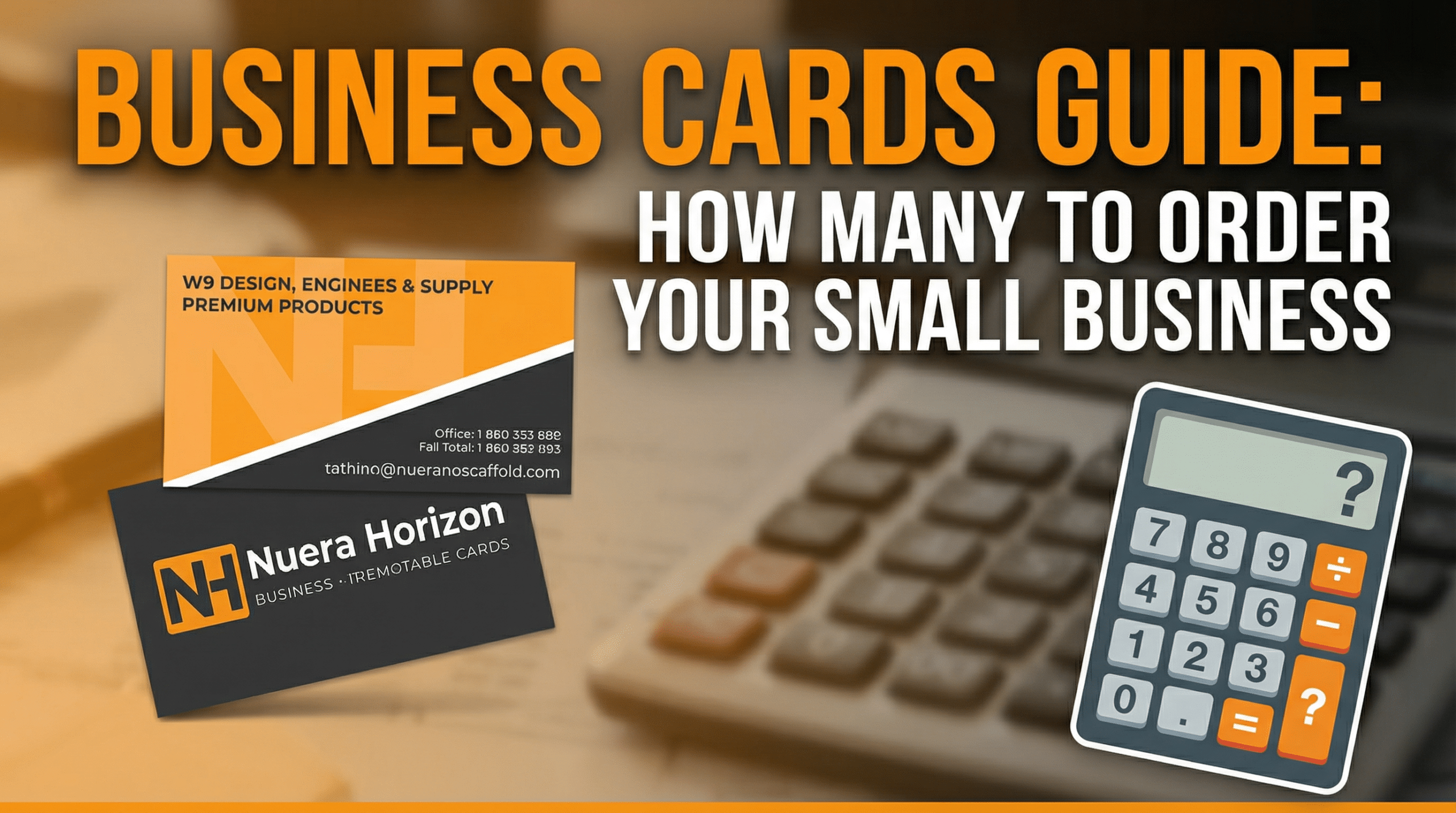
Business Cards Guide: How to Calculate Your Order Quantity
Knowing how many Business Cards to order is a common question for small business owners. Order too few, and you may run out during an important networking stretch. Order too many, and you risk wasting money if your phone number, title, logo, or offer changes. A practical Business Cards Guide helps you find the right balance between cost, convenience, and flexibility.
Your ideal quantity depends on how you actually use your cards. Some businesses hand out only a few each week. Others distribute dozens at trade shows, local events, client meetings, retail counters, and referral partnerships. The best order size is based on expected usage over a set period, usually three, six, or twelve months.
Key factors that affect order quantity
- How often you attend networking events or community functions
- How many client meetings or sales calls you handle each month
- Your average lead volume and follow-up activity
- Whether multiple team members need cards
- How stable your branding and contact details are
- Your budget for printing and reordering
Business Branding also plays a role. If you recently updated your logo, colors, or messaging, a smaller first run may be smarter. If your brand is established and your details are unlikely to change, a larger print order often lowers your cost per card and supports consistent Advertising and Marketing.
Print style matters too. Standard cards are often economical for higher-volume use, while premium options may be better for targeted outreach. If you want a refined feel for selective handouts, you might explore matte silk laminated business cards. For brands that want a modern tactile finish, soft touch business cards can help make each interaction more memorable.
This Guide will help you estimate demand, calculate your ideal order size, and choose a quantity that supports growth without overcommitting your budget.
Why ordering the right number of business cards matters
The number of Business Cards you order affects more than print cost. It influences how consistently you present your brand, how prepared you are for opportunities, and how efficiently you manage your Marketing materials. For small business owners, the right quantity helps you stay visible without creating unnecessary waste.
If you order too few
Running out of cards at the wrong time can hurt momentum. You may miss a referral, fail to support a face-to-face introduction, or leave an event without giving prospects a simple way to remember you. Even in a digital world, a business card still serves as a quick physical reminder of your Business Branding.
- Missed leads during networking or trade events
- Less professional presentation in meetings
- Higher rush-order costs when stock runs low
- Interrupted Advertising and local outreach efforts
If you order too many
Overordering can create a different problem. Small businesses often evolve quickly. A change in phone number, website, service offering, address, or team structure can make a large inventory outdated. That means lost money and inconsistent branding in the market.
- Wasted inventory after contact or brand updates
- Cash tied up in materials you may not use soon
- Boxes of cards taking up storage space
- Old messaging remaining in circulation
The business case for getting it right
A smart order quantity protects your budget while keeping you ready to promote your business. It supports a steady brand presence across meetings, events, retail counters, and referral exchanges. It also helps you choose the right print quality for your goals. For example, if you want a standout format for selective high-value conversations, die cut business cards can strengthen brand recall. If you want a polished premium stock for frequent use, ultra smooth business cards can support a sharp, professional impression.
In short, the right quantity keeps your Business Cards working as an active part of your Marketing system rather than an afterthought or an unnecessary expense.
Estimate demand: events, networking, clients, and lead volume
Before you place an order, estimate how many Business Cards you are likely to use in real situations. Small business owners usually get the best results by forecasting card demand across four channels: events, networking, client activity, and lead generation. This approach turns a guess into a usable planning number.
1. Events and trade shows
Start with your calendar. If you attend expos, pop-up markets, chamber meetings, or vendor fairs, estimate how many cards you typically hand out at each one. For some businesses, this may be 25 per event. For others, it may be 100 or more.
- Number of events planned in the next 3 to 12 months
- Average card handouts per event
- Extra cards for display tables or staff use
2. Weekly networking habits
If you attend breakfast groups, local meetups, referral circles, or one-to-one meetings, calculate your monthly average. Regular networking often creates steady card usage even when large events are infrequent.
3. Client and sales pipeline
Think about consultations, site visits, estimates, and in-person service appointments. If each client interaction typically involves one or two cards, your active sales pipeline can be a strong predictor of future need.
- Monthly consultations or sales meetings
- New client onboarding packets
- Partner referrals and leave-behind materials
4. Growth plans and team expansion
Your Guide should account for where the business is going, not just where it is today. If you expect more outreach, new hires, or expanded local Advertising, increase your estimate accordingly. Fast-growing businesses often underestimate usage because they plan based only on recent history.
A useful method is to review the last 60 to 90 days, identify your average monthly card usage, and then adjust for upcoming campaigns, seasonal demand, and new opportunities. Add a small buffer so you stay prepared. Forecasting demand this way helps align your Business Cards order with real-world Marketing activity instead of relying on guesswork.
How to calculate your ideal order (step-by-step)
The easiest way to decide how many Business Cards to order is to use a simple formula. This step-by-step Guide gives small business owners a repeatable way to estimate needs for the next three, six, or twelve months while leaving room for growth.
Step 1: Calculate your monthly usage
Add up the number of cards you expect to distribute in an average month.
- Event cards per month
- Networking cards per month
- Client meeting cards per month
- Display or front-desk cards per month
Example:
- Events: 40
- Networking: 30
- Client meetings: 20
- Front desk: 10
Total monthly usage: 100 cards
Step 2: Choose your planning window
Select how far ahead you want to print.
- 3 months for newer businesses or changing branding
- 6 months for stable, moderate usage
- 12 months for established branding and predictable demand
Using the example above:
- 3-month need: 300 cards
- 6-month need: 600 cards
- 12-month need: 1,200 cards
Step 3: Add a safety buffer
Add 10% to 25% for unexpected opportunities, busy seasons, or staff needs. If your six-month estimate is 600 cards, a 20% buffer brings your order to 720.
Step 4: Round to a practical print quantity
Printers often offer common quantity breaks such as 250, 500, 1,000, or 2,500. Round up to the nearest sensible amount based on price and flexibility. In the example above, 750 or 1,000 may be the best fit depending on your budget and how stable your contact details are.
Simple template
Monthly usage x number of months + buffer = ideal order quantity
Example template:
(100 x 6) + 20% = 720 cards
Recommended order: 750 or 1,000
This calculation keeps your Business Cards aligned with real Marketing demand while protecting your Business Branding from waste caused by overordering.
Design, branding, and when to reprint
Your reorder timing is not only about how fast you hand out Business Cards. It is also about how stable your brand, contact details, and sales message are. For small business owners, the smartest approach is to match card quantity to how likely your information or design is to change in the next 3 to 12 months.
If your company is still refining its logo, tagline, phone number, website, or service mix, avoid over-ordering. A large batch may lower your per-card cost, but outdated cards can create confusion and weaken Business Branding. In that case, a smaller run is often the better Marketing decision.
When a reprint makes sense
Reprint your cards when a change affects trust, clarity, or consistency. Even small updates matter if they change how customers contact you or remember your business.
- New phone number, email address, or website URL
- Updated logo, colors, or brand positioning
- New job title or expanded services
- Change of address or additional location
- Outdated social media handles or QR code destination
A good Business Cards Guide rule is simple: if a customer might hesitate because the card feels outdated, reprint.
How branding choices affect reorder cadence
Cards with timeless branding usually last longer. Clean layouts, stable contact channels, and evergreen messaging reduce the need for frequent revisions. By contrast, promotional cards tied to short-term offers, seasonal campaigns, or fast-changing Advertising messages will need more frequent reorders.
Material choices can also influence how often you reorder. Premium finishes may support a stronger first impression, which can justify smaller, more intentional runs. If you are considering an upgraded look, options such as soft touch business cards, ultra smooth business cards, die-cut business cards, or matte silk laminated business cards can align the card with your brand image.
Use your reorder plan as part of your broader Guide for print consistency. If your business is evolving quickly, order smaller quantities more often. If your branding is established and your details rarely change, larger runs make more sense.
Cost, budgeting, and inventory management for business cards
The most economical order size is not always the biggest one. Small business owners should balance unit price, cash flow, storage, and the risk of outdated inventory. A practical Business Cards Guide looks at total value, not just the lowest cost per card.
Common quantity thresholds
Most printers offer noticeable pricing breaks at standard quantities such as 100, 250, 500, 1,000, and 2,500 cards. As the order size increases, the per-card cost usually drops. That makes larger runs attractive for established businesses with stable Business Branding and predictable demand.
However, lower per-card pricing can be misleading if you end up discarding unused cards after a rebrand, staffing change, or contact update. Waste erodes the savings.
How to budget smartly
- Order 100 to 250 cards if your business information may change soon.
- Order 500 cards if you network regularly and your brand is mostly settled.
- Order 1,000 or more if you have steady lead volume, multiple events, and long-term brand consistency.
For many owners, the best middle ground is 500 cards. It often provides a better unit price than a very small run while limiting the risk of overstock.
Inventory management tips
Treat Business Cards like any other printed Marketing asset. Track how many you use each month and set a reorder point before you run out. A simple spreadsheet or monthly check-in can prevent last-minute rush orders.
- Count your starting inventory.
- Track usage by month or event.
- Estimate how many weeks of stock remain.
- Reorder when you have 20% to 25% left.
Store cards in a cool, dry place away from sunlight and moisture. Keep boxed inventory flat and clean to prevent curling, fading, or damaged corners. This is especially important for premium finishes used in Advertising and client-facing interactions.
The right quantity supports ROI by reducing waste, protecting cash flow, and ensuring you always have polished materials ready when opportunities appear.
Practical tips: how many cards to carry, distribute, and store
Once you know how many Business Cards to order, the next question is how many to keep on hand each day. For small business owners, the answer depends on your schedule, how often you meet new people, and whether you attend events, sales calls, or walk-in appointments.
How many cards to carry daily
A reliable range for everyday use is 10 to 20 cards. That is enough for typical meetings, chance introductions, and client conversations without overstuffing your wallet or card case. If you are in outside sales, real estate, home services, or event-heavy Marketing, you may want to carry 25 to 50.
- Light networking day: 10 to 15 cards
- Client meetings: 15 to 20 cards
- Trade show or event: 50 or more
- Team members working booths: issue cards per shift
How to distribute cards effectively
Do not think of Business Cards as something to hand out randomly. They work best when given during a meaningful interaction. That keeps your Advertising more targeted and improves the chance that someone keeps the card.
Good moments to offer a card include:
- After introducing your business and services
- At the end of a consultation or estimate
- When someone asks for your contact details
- When making a referral connection
At events, bring more than you expect to use, but do not place stacks everywhere unless the setting supports it. Personal exchange usually performs better than passive distribution.
Best practices for replenishment and storage
Keep a small backup supply in your car, office, and bag so you are never caught empty-handed. Refill your daily carry case at the end of each week or after every event. If your team uses cards, assign each person a set amount and monitor usage patterns.
Store extra inventory in its original box in a dry, protected area. Rotate older stock forward so cards are used in order. As part of your ongoing Business Cards Guide, review carry habits every few months. If you always run out, carry more. If you rarely hand them out, reduce your daily amount and reorder less often.
The best business card order is one that matches your real sales activity, budget, and expected branding changes. If you estimate usage carefully and review your reorder timing regularly, you can avoid waste while always having cards ready to hand out. If you are planning a new print run, use these guidelines to choose a quantity that fits your business today and leaves room for growth.
Related Products and Services
If you are planning a similar project, these related options may help.
Helpful External Resources
These sources provide supporting background and additional context.
How many business cards should a small business owner order initially?
Business Cards Guide: start with 250–500 cards for most small businesses—250 if you’re testing a design or have limited networking, 500 if you attend events regularly. This balances cost, shelf life, and the risk of information or branding changes.
Is it better to order 250, 500, or 1,000 business cards for cost savings?
Per-card cost decreases as quantity increases, so 500 or 1,000 offers the best unit price. Order 500 if you want savings with manageable inventory; choose 1,000 only if you’re confident the design and contact details won’t change soon.
How often should I redesign and reprint my business cards?
Redesign or reprint every 1–3 years or whenever your branding, title, or contact details change. Reprint sooner if your networking needs shift, your card becomes outdated, or you want to test a new design.
How many business cards should I carry with me daily and to events?
Carry 10–25 daily for meetings and casual encounters. For networking events, bring 100–250 depending on event size; for trade shows or conferences where you expect heavy leads, bring 250–500.