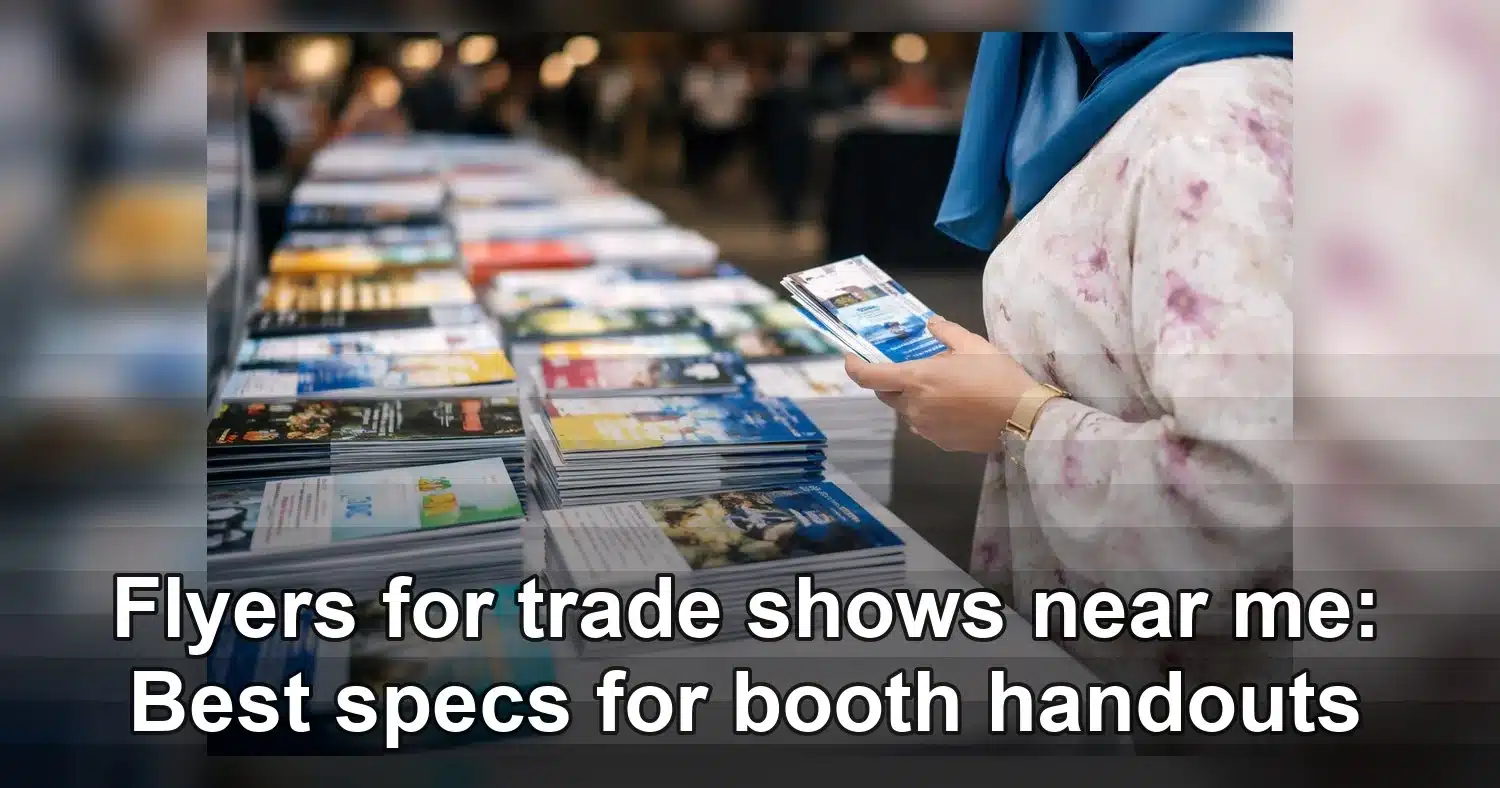
If you are searching for flyers for trade shows near me, the best results usually come from a local print partner that can match your booth goals, quantity, paper stock, and turnaround to the event date. That matters whether you need same-day pickup, next-day delivery, or a custom handout for a convention center deadline. For local business owners, a trade show flyer is not just a piece of paper. It is a fast sales tool that should be easy to read, easy to carry, and built to support scans, offers, and follow-up.
Last updated: May 2026
Ready to print flyer printing?
Send your artwork, quantity, and deadline to Branding Centres. We will help confirm specs, turnaround, and the best production option.
This guide explains how to choose the right flyer format, what specs work best on a busy expo floor, how local timelines affect production, and what drives pricing. If you want a finish that stays readable under bright venue lighting, take a look at matte finish flyers for trade show handouts. For broader planning context, these trade show ideas are a useful reminder that clear messaging and well-designed print pieces help exhibitors stand out.
How to choose flyers for trade shows near me
The best flyers for trade shows near me are the ones that fit your traffic, your offer, and your deadline. A local event gives you more control because you can often review a proof in person, pick up the order yourself, and make quick changes if your booth message shifts. That flexibility is valuable when you are testing a new promotion or tailoring content to a specific city, industry, or audience.
Start with the job the flyer has to do
Before you design anything, decide what the flyer should accomplish. A flyer for a busy expo floor should do one thing quickly: get the attendee to stop, scan, or take action. If you are using it for lead generation, keep the message focused on one service, one offer, and one clear call to action. If you are using it as a leave-behind, give it a little more detail so the prospect remembers you after the show.
Choose the format based on booth traffic
High-traffic booths need handouts that can be picked up in seconds. Smaller events or appointment-based trade shows can support a more detailed flyer because visitors have time to read. If people are likely to walk past your booth quickly, a single-page flyer is usually better than a folded piece that takes longer to explain.
Plan around pickup, delivery, or rush printing
Local businesses benefit from short turnaround options, especially when a show date changes or a campaign gets approved late. If your printer offers same-day pickup or local delivery, you can often print closer to the event and avoid overordering. That becomes especially useful when you are updating pricing, adding a QR code, or tailoring the flyer to a specific venue.
Keep one version for the booth and one for follow-up
Many exhibitors use two versions: a quick handout for the booth and a fuller flyer for prospects who want more detail. Trade show print planning often groups flyers with other booth materials such as brochures and business cards, which is a good reminder to match the flyer to the buyer journey. Use the short version to drive action now, then use the detailed version to support sales later.
Flyer specs that work on a crowded expo floor
The best expo marketing flyers are easy to read in seconds, even when someone is walking past your booth. That means choosing a practical size, enough contrast, and a layout that puts the main message above everything else. The goal is not to say everything. The goal is to say the right thing fast.
Use a size that is easy to hold and scan
For crowded aisles, standard letter size and half-page handouts are usually the easiest to stack, display, and carry. An 8.5 x 11 flyer gives you room for offers, service lists, and a clear call to action. Half-page flyers are better when you want something compact that fits easily into a bag or folder without folding.
Pick a paper weight that feels substantial
Thin paper can look temporary, which is not ideal when you want to position your business as credible. A heavier stock gives the flyer more presence and helps it survive being carried around an expo floor. If you want a more premium feel, consider finishes like matte finish flyers or a tactile uncoated stock for notes and referrals.
Choose finish and color for readability
Gloss can make photos pop, but strong lighting on a trade show floor can create glare. Matte finishes reduce reflection and are often easier to read under bright convention hall lights. Keep color purposeful: use one strong accent color for the headline or CTA, and leave enough white space so the flyer does not feel crowded. If your brand depends on a clean, premium presentation, linen uncoated flyers can add texture without making the layout harder to read.
Design for QR codes and fast headlines
Put the headline near the top and make it benefit-driven. A good trade show headline says what you do and why someone should care. Keep body copy short, and make the QR code large enough to scan from arm’s length. Add a short label next to it, such as Scan for pricing or Book a demo, so attendees know what they will get.
Use a short checklist before you print
- One clear headline
- One primary offer or takeaway
- Readable font size from a few feet away
- Strong contrast between text and background
- QR code that goes to a mobile-friendly landing page
- Local phone number or booth contact email
Booth handouts compared: flyer sizes and formats that sell best
The right booth handout depends on how much information your attendees need and how long they spend at your display. Single-page flyers work best for quick decisions, while folded pieces and leave-behinds are better when your sales process needs more explanation. Choosing the right format keeps the conversation moving and prevents the flyer from feeling overloaded.
| Format | Best use case | Reading time | Pros | Watch out for |
|---|---|---|---|---|
| Single-page flyer | Lead capture, promotions, one-service offers | Under 30 seconds | Fast to scan, easy to stack, inexpensive to reprint | Too much text can make it feel crowded |
| Half-page handout | Giveaways, quick reminders, event specials | 10 to 20 seconds | Compact, portable, good for high-traffic booths | Less room for details or multiple offers |
| Folded piece | Product lines, service menus, multi-step sales | 30 to 90 seconds | More space for sections, charts, and testimonials | Can slow down the handoff if the design is too dense |
| Leave-behind flyer | Sales meetings, scheduled demos, post-booth follow-up | 1 to 3 minutes | Supports deeper selling and helps prospects remember you | Needs stronger branding and a clear next step |
Single-page flyers work best when speed matters
If your booth relies on quick conversations, a single-page handout is usually the strongest choice. It lets you present one offer, one proof point, and one CTA without forcing the attendee to flip pages. This format works well for promotional pricing, event-only discounts, and booth handouts that need to be distributed in volume.
Folded pieces are better for explanation
When your product or service needs more context, folded expo marketing flyers give you room to organize information into sections. Use the front panel for the headline and the inside for features, benefits, and contact details. This is a good option for companies with multiple service lines, especially if you want to hand the same piece to different visitor types.
Leave-behinds help after the first conversation
Leave-behinds are designed for follow-up, not just pickup. They should include enough detail to support a later call, quote request, or website visit. If your booth staff is qualifying leads on the spot, the leave-behind can work as a mini sales sheet with product comparisons, testimonials, and a strong next step.
Choose the format that matches your booth flow
If attendees stop briefly, keep the flyer simple. If they sit down or ask for a demo, use a format with more depth. Many exhibitors mix formats by printing a quick handout for everyone and a second, more detailed piece for qualified prospects. That approach keeps your booth efficient while still supporting serious buyers.
Local print timelines for expo marketing flyers
The fastest way to avoid missed deadlines is to work backward from exhibitor move-in, not from the show opening time. For local orders of flyers for trade shows near me, a realistic timeline depends on proof approval, file readiness, finishing, and whether you need pickup or delivery to the venue. A little scheduling discipline can save you from expensive rush fees and stressful last-minute changes.
How proofing affects turnaround
Proofing is usually the first bottleneck. If your artwork is print-ready, many local shops can send a digital proof within a few hours. If your file needs fixes such as bleeds, image cleanup, or font replacement, that can push production into the next day. A good rule is simple: approve your proof before noon if you want the best shot at same-day printing.
- Print-ready PDF with correct size, bleed, and CMYK color: fastest path
- Design revisions after proof approval: commonly add half a day to a full day
- Special finishes or folding: often move the job out of same-day range
Same-day, next-day, pickup, and delivery
Same-day service is usually available for standard flat flyer runs, especially 5.5 x 8.5 or 8.5 x 11, on common stocks with no complex finishing. Next-day is more realistic when you need larger quantities, premium paper, or multiple versions. Many event printers promote rush support for trade show materials, including short-turnaround local jobs, as shown by trade show and event printing services with rush options.
Local pickup is often safer than delivery when you are close to the print shop. It removes courier delays and gives you a chance to inspect the order before heading to the convention center. Delivery is useful when your team is already on site, but you should confirm the venue receiving hours, required labeling, loading dock access, and the cutoff time for same-day messenger service.
Plan around convention center deadlines
Convention centers often have strict material handling windows. If exhibitor freight must arrive by 3 p.m. or booth setup closes at 6 p.m., do not schedule flyer completion for the final hour. Build in at least a half-day buffer for reprints, traffic, and dock access delays. If the handouts are critical to lead generation, split the run: pick up a smaller quantity first for opening day, then restock later.
What affects pricing for exhibitor flyers
The price of exhibitor flyers is driven less by the word flyer and more by the exact production choices behind it. Quantity, paper stock, finish, color coverage, design support, and rush timing all change the final cost. When you compare quotes, it helps to break the order into those parts instead of looking at one total price.
Quantity and run size
Higher quantities usually reduce the cost per piece, but they also increase the total order value. If you need 250 for a one-day expo, ordering 2,500 just to chase a lower unit price can be wasteful. Local businesses often do better with a right-sized run plus a small reorder option.
- 100 to 250 pieces: best for targeted local events or premium conversations
- 500 to 1,000 pieces: common for active booth traffic
- 2,500 and up: lower unit cost, but higher risk of leftovers
Stock and finish choices
Paper weight changes both look and price. Thin economy stock costs less, but it can feel disposable on an expo floor. Heavier text or cover stocks raise cost but improve perceived value. Finish matters too. matte finish flyers are easy to read under bright hall lighting and resist fingerprints. linen uncoated flyers feel more premium and work well for service brands, but they usually cost more than standard coated paper. If you want extra shine, high-gloss UV coating adds impact and durability, though it can increase both production time and budget.
Color coverage, design help, and rush fees
Full-color printing on both sides costs more than light coverage or one-sided printing. Heavy ink coverage, dark backgrounds, and photo-rich layouts can also increase setup sensitivity and spoilage risk. Design help adds to the total if your printer needs to build the layout, source images, create a QR code, or prepare multiple versions for different offers.
Rush fees are often the biggest surprise. Same-day or next-day production can add a meaningful premium, especially if the order interrupts a normal press schedule. Ask for line-item pricing so you can compare the base print cost, paper upgrade cost, finish or coating cost, design or file repair charges, and rush production or local delivery fees.
How to make booth handouts generate more leads
The best booth handouts do one job well: they move a visitor from casual interest to a trackable next step. A flyer that only lists services gets skimmed and tossed. A flyer with a clear offer, strong call to action, and measurable follow-up path can keep working after the event ends.
Lead with one event-specific offer
Give attendees a reason to act now instead of later. Tie the handout to the event with a simple, deadline-based incentive.
- Book a consultation within 7 days for a free audit
- Scan for an expo-only sample pack or demo
- Bring this flyer to your local showroom for a discount
- Use an event code for preferred pricing
Keep the offer singular. Too many options weaken response and make the flyer look generic.
Use a call to action people can follow in seconds
Your call to action should be visible from arm’s length and repeated once near the bottom. Good examples include Scan to schedule, Claim your expo offer, or See local pricing. Print and marketing providers that share trade show marketing ideas regularly stress having a specific next step rather than a general brand message.
Make QR codes and URLs easy to track
Use one QR code that sends visitors to an event-specific landing page, not your homepage. Add a short vanity URL below it for people who do not want to scan. The page should match the flyer headline and capture contact details with as little friction as possible.
- Create a unique URL for each event
- Use a simple form with name, email, and one qualifying question
- Tag submissions by show name for sales follow-up
- Test the QR code from different phones before printing
Prompt the follow-up before they walk away
Include one line that tells the prospect what happens next: Scan now and we will send your comparison guide today or Visit this page to book a 15-minute post-show call. That reduces uncertainty and improves conversion. For local business owners, it also helps to mention geography directly, such as service area, local pickup, or nearby showroom availability, so the handout feels relevant to the market where the event is happening.
Common mistakes with expo marketing flyers and how to avoid them
The biggest mistakes with expo marketing flyers are simple: too much information, weak branding, the wrong paper stock, and no clear way to contact you after the show. If you are ordering flyers for trade shows near me from a local printer, catching these issues before approval is one of the easiest ways to avoid wasted print spend and low-quality booth conversations.
1. Cramming in too much copy
A flyer is not a brochure. On a busy expo floor, people give most exhibitor flyers only a few seconds of attention. When every inch is filled with text, tiny bullet points, and multiple offers, your main message disappears.
- Keep one headline, one offer, and one call to action.
- Limit body copy to the essentials: what you do, who it is for, and why it matters.
- Use white space so the eye lands on the key point fast.
If you need to explain more, send visitors to a landing page instead of forcing every detail onto the handout.
2. Weak or inconsistent branding
Many booth handouts look generic because the logo is too small, the colors do not match the booth, or the design looks like a template from another company. That hurts recall, especially since most exhibitors use a mix of flyers, brochures, postcards, and booth signage at the same event.
Match your flyer to your display with the same logo placement, brand colors, typefaces, and offer language. A prospect should be able to glance at the handout later and instantly remember your booth.
3. Choosing paper that fights the job
Paper choice changes how your flyer feels, reads, and survives the event. Cheap thin stock can curl, scuff, or look washed out under expo hall lighting. Ultra-glossy finishes can reflect overhead lights and make text harder to read.
For easy reading and a more refined look, many local businesses do better with matte finish flyers. If you want a tactile premium feel for higher-end services, linen uncoated flyers can stand out without feeling flashy. High-gloss can still work for bold product photos, but only if glare will not be a problem.
4. Forgetting the next step
A surprising number of expo marketing flyers leave out basic follow-up details. No phone number, no email, no QR code, no location, or a URL that sends people to a generic homepage means leads go cold fast.
- Add a direct contact name or department.
- Use a short, trackable URL or QR code tied to the event.
- Include your city or service area if local business matters.
- Repeat the call to action near the bottom, not just once at the top.
Before you send files to print, do one final proof check: can a local prospect tell who you are, what you offer, and exactly how to reach you in under 10 seconds? If not, revise before you print.
Before you place your order, confirm the event date, booth traffic goals, quantity, paper stock, and whether pickup or delivery fits your timeline best. A simple proof check for headline size, QR code placement, and contact details can prevent costly reprints. If you are comparing options now, use the sections above to narrow your flyer format first, then request pricing based on your deadline and quantity so you can choose the best fit for your next show without overordering.
Related Products and Services
If you are planning a similar project, these related options may help.
- Matte Finish Flyers
- Linen Uncoated Flyers
- Uv (High Gloss
- Flyers
Helpful External Resources
These sources provide supporting background and additional context.
What size is best for flyers for trade shows near me?
For most booths, 8.5 x 11 inch flyers are the safest choice because they are easy to read, easy to stack, and flexible enough for offers or service details. If you want something that fits easily into bags, folders, or sample kits, 5.5 x 8.5 inch flyers also work well. Choose a larger size only if you truly need more space for charts, pricing, or multiple calls to action.
Should trade show flyers be glossy or matte?
Glossy flyers can make photos and color blocks look sharper, but they may create glare under bright convention hall lighting. Matte flyers reduce reflection and are often easier to read from a distance. If your flyer is text-heavy or includes a QR code, matte is usually the better option.
How many flyers should I order for a local expo?
Order based on expected traffic, not just booth size. A smaller local event may only need 250 to 500 flyers, while a busy show can require 1,000 or more. If you plan to hand them out directly and place them at the booth, bring extra so you do not run out before the event ends.
Can I get same-day printing for trade show flyers?
Yes, same-day printing may be possible if you choose a standard size, a simple stock, and send a print-ready file early in the day. Availability depends on the printer’s schedule and finishing needs, so it is best to call ahead and confirm pickup time before placing the order.
What file should I send for flyer printing?
A print-ready PDF is usually the best option. Set the file up at final size, include bleed, keep images at 300 DPI, and use CMYK color if possible. If you are unsure about the setup, ask the printer to review the file before production begins.
Are flyers good for trade show lead generation?
Yes, flyers can be an effective and affordable lead generation tool when the message is focused and the call to action is clear. They work best when they support a specific event offer, point people to a trackable landing page, and match the look of your booth.
Get a Free Quote Today
Contact us at +1-(416) 288-8661 or Email us at info@Brandingcentres.com and let's get started.