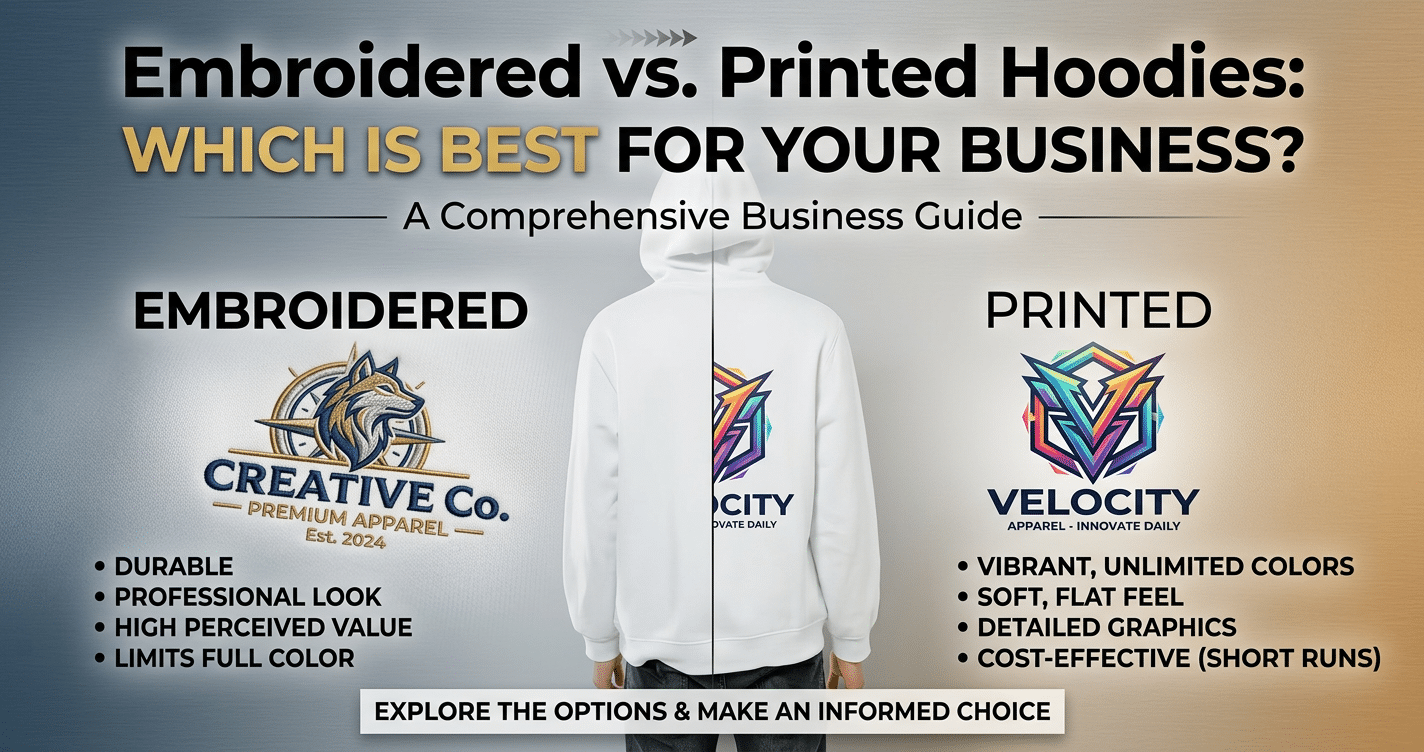
Embroidered vs Printed Hoodies is usually a decision about brand presentation, artwork type, budget, and how the hoodie will be used in real life. Embroidery tends to create a more polished, durable, and premium finish for uniforms, corporate apparel, and client-facing teams. Printing is usually the better fit for detailed graphics, larger artwork, colorful designs, and orders where cost per piece and turnaround speed matter most. For business buyers, the best choice is rarely the “better” decoration method in general. It is the method that matches your logo, garment, quantity, and the impression you want the hoodie to make.
Last updated: March 2026
That distinction matters because hoodies are not just casual apparel. They can work as staff uniforms, promotional giveaways, retail merchandise, event apparel, or branded client gifts. A stitched logo can communicate consistency and professionalism. A printed graphic can communicate energy, creativity, and visibility. If you choose the wrong method, you can end up with a design that looks awkward, costs more than expected, or does not perform well after repeated wear. If you choose the right method, the hoodie becomes a useful brand asset that looks good, lasts well, and fits the job it was made for.
In practical terms, embroidery adds texture and structure. Printing adds flexibility and visual range. Embroidered hoodies are often the stronger choice for simple logos placed on the chest or sleeve. Printed hoodies usually win when the artwork needs multiple colors, gradients, oversized placement, or a softer, flatter feel. The right answer depends on what your business is trying to communicate and how the hoodie will actually be used.
What Embroidery and Printing Change on a Hoodie
Before comparing price or style, it helps to understand what these methods actually do to the garment. Embroidery uses thread stitched into the fabric, while printing applies ink or transfer material to the hoodie surface. That sounds simple, but the difference changes three important things: texture, durability, and how the branding reads from a distance.
How embroidery behaves
Embroidery sits on top of the hoodie and creates a raised, tactile finish. On heavier fleece and structured hoodies, it can look crisp, substantial, and refined. It is especially effective for company logos, initials, monograms, and other simple marks that do not rely on tiny detail. Because the design is built from thread, embroidery has a dimensional quality that can make a brand feel established and intentional.
There are limits, though. Very small lettering, thin line art, and complex shading can lose clarity when translated into stitches. Oversized embroidery can also make a garment feel stiff or dense in the decorated area. That is why embroidery usually works best when the logo is compact, bold, and well-suited to simplified reproduction.
How printing behaves
Printing lays the artwork onto the hoodie, which allows for more visual detail and more freedom with size. It is a strong choice for large graphics, multi-color designs, gradients, and artwork that needs a softer hand feel. Depending on the print method, the design may sit almost flat against the fabric and feel lighter than embroidery.
Printing is often the easier route when the artwork looks more like a poster, illustration, campaign image, or retail graphic than a corporate logo. It can also be more practical when you need to decorate a large area such as the full chest or back. For many brands, that makes printing the better choice for promotions, events, or merch drops.
What business buyers should focus on
The most useful way to compare embroidered and printed hoodies is to ask three questions:
- What does the artwork require? Clean logo or detailed graphic?
- How will the hoodie be used? Uniform, giveaway, retail product, or gift?
- What impression should it create? Premium and professional, or bold and high-visibility?
Answering those questions usually points to the correct decoration method faster than comparing price alone.
Embroidered vs Printed Hoodies: Side-by-Side Comparison
The easiest way to compare Embroidered vs Printed Hoodies is to look at how each method performs in business use, not just how each one looks on a sample.
| Factor | Embroidered Hoodies | Printed Hoodies | What It Means for Buyers |
|---|---|---|---|
| Look and feel | Raised, textured, and more structured | Flatter, smoother, and often lighter | Choose embroidery for a premium finish and printing for a softer graphic feel |
| Durability | Very strong for repeated wear when the design is simple | Depends on print method, ink quality, and wash care | Embroidery is often better for long-term uniforms |
| Artwork detail | Best for bold lettering, logos, and simple shapes | Best for gradients, fine lines, and complex art | Printing is the safer choice for detailed designs |
| Cost | Often higher setup and per-piece cost | Usually more budget-friendly for larger or colorful designs | Printing often gives better value on promo orders |
| Turnaround | Can take longer because of digitizing and stitch setup | Often faster when the artwork is ready | Printing is usually easier for short deadlines |
| Best order size | Works well for smaller premium runs and core uniforms | Scales well for events, campaigns, and merch | Match the method to quantity and use case |
| Brand impression | Professional, durable, and refined | Creative, bold, and visually flexible | Choose based on the brand message you want to send |
There is also a production difference that affects the final result. Embroidery usually needs digitizing before it can be stitched, which adds a preparation step but improves consistency. Printing depends more on the artwork file, fabric compatibility, and print method. A design that works beautifully on one hoodie fabric may not perform the same way on another, so garment choice matters as much as decoration choice.
When Embroidered Hoodies Look More Premium
Embroidered hoodies usually create the more premium look when the goal is a polished, professional presentation. That is one reason they are so common for company uniforms, executive apparel, hospitality teams, retail staff, and client gifts. A stitched logo often feels more substantial than a printed one because it adds dimension and a sense of craftsmanship.
Best use cases for embroidery
Embroidery is usually the stronger option for:
- Staff uniforms and team apparel
- Client gifts and corporate giveaways
- Minimal logos and wordmarks
- Left-chest branding
- Premium fleece and heavier hoodies
For staff uniforms, embroidery sends a clear message. It says the apparel was chosen intentionally, not as an afterthought. That matters for businesses where employees interact with customers in person, because the hoodie becomes part of the brand presentation. A clean stitched logo can make a team look coordinated, dependable, and established.
For client gifts, embroidery often increases perceived value. A small logo on a well-made hoodie can feel thoughtful without being loud. This is especially effective when the rest of the garment is simple and well-fitted. If the goal is to make the recipient feel appreciated, embroidery usually has an advantage because it reads as more refined.
For premium uniforms, embroidery also tends to be more visually stable over time. A stitched logo does not rely on ink staying perfectly smooth, and it often holds its appearance through repeated laundering better than a low-grade print. That makes it a smart choice when apparel needs to stay in rotation for months or years.
When printing can still look premium
Printing can also look premium, but usually in a different way. Rather than feeling classic and structured, printed hoodies often feel modern, creative, and retail-inspired. A large, well-designed print on a quality hoodie can look more like a fashion piece than a corporate item. That is why printing is often the better premium option for brand launches, merch drops, and event apparel.
If the art is bold, graphic, or editorial, printing can create more impact than embroidery. A full-front illustration or oversized back design can turn a hoodie into a statement piece. In those situations, embroidery may feel too small or too restrained to carry the design properly.
When Printed Hoodies Are the Better Choice
Printed hoodies are usually the better choice when the artwork is detailed, colorful, or intended to cover a larger area. Printing offers more flexibility with visual style, which makes it a strong fit for promotional campaigns, seasonal merchandise, and designs that need more than a simple logo treatment.
Best use cases for printing
Printing is often the better option for:
- Event apparel and campaign merchandise
- Full-front or full-back graphics
- Multi-color logos and detailed illustrations
- Photo-style or gradient artwork
- Lower-cost bulk promotional orders
For trade shows, concerts, community events, school programs, and branded activations, printing can be especially effective because the design can be larger and more visible. If people need to spot the logo from across a room, a printed hoodie often does that better than a small embroidered chest mark.
Printing is also useful when the artwork changes from one campaign to the next. If you are producing hoodies for different teams, seasons, or events, printing gives you more freedom to vary the message without redesigning the decoration process every time. That flexibility can save time and keep your apparel strategy more adaptable.
Another advantage is cost control. While pricing depends on the print method, the garment, and the order size, printed hoodies often provide a lower entry point for designs that would be expensive or impractical to stitch. For businesses that need quantity and visual impact more than texture, printing is usually the smarter investment.
Pricing, Minimums, and Turnaround Expectations
Pricing differences between embroidered and printed hoodies usually come from setup, artwork complexity, quantity, and garment type. Neither method is automatically cheaper in every case, but each has a typical cost pattern.
What drives the price
- Setup work: embroidery requires digitizing, while printing may require file prep or screen setup
- Artwork complexity: more colors, more detail, and larger placements often increase cost
- Garment choice: heavyweight fleece, specialty fabrics, and technical blends can affect production
- Order quantity: larger orders usually reduce the per-unit price
- Placement: chest logos are easier than sleeve, hood, or oversized back decoration
Many businesses are surprised by how much quantity changes the economics. A 12-piece order may cost much more per hoodie than a 50-piece or 100-piece run. That is because setup costs are spread across fewer garments. If you are ordering for a team or event, it is often worth asking for pricing at several quantity breakpoints so you can see where the best value begins.
Typical turnaround times
Production timelines vary by supplier, decoration method, and garment availability, but a common planning range looks like this:
- Standard production: about 7 to 14 business days after proof approval
- Rush production: sometimes 3 to 7 business days if stock and capacity allow it
- Complex orders: longer timelines if digitizing, sourcing, proof revisions, or multi-location decoration are involved
Embroidery often takes longer than printing because the artwork must be converted into a stitch file before production. Printing can move faster when the file is already prepared and the garment is in stock. If you have a deadline for onboarding, an event, or a launch date, build in extra time for artwork approval and revisions.
How to compare quotes properly
When you ask for pricing, make sure the quote includes the decoration setup, shipping, and any applicable taxes or fees. A quote that looks lower on the surface may not be the best value if it leaves out digitizing, garment upgrades, or rush charges. To compare embroidered and printed hoodies fairly, ask the supplier to price the same hoodie style, same quantity, and same placement across both methods.
Artwork Detail, Fabric Type, and Placement
Not every hoodie can support every kind of decoration equally well. The artwork, the fabric, and the placement all influence whether embroidery or printing will produce the better result.
When embroidery works best
Embroidery is strongest when the artwork is compact and simple. It works well with logos, initials, crests, and short text. It also performs better on fabrics with enough body to support the stitching, such as heavier fleece and structured cotton hoodies.
- Best for: simple logos, monograms, and small branding
- Good on: fleece, heavyweight cotton, and structured hoodies
- Less ideal for: tiny lettering, gradients, and highly detailed art
If you want a polished chest logo on a warm, structured garment, embroidery is often the cleanest solution. It is especially effective when the logo does not need to be large to make an impact.
When printing works best
Printing is the better choice when the design depends on detail or scale. It can handle larger artwork, layered color, and more complex visual styles. That flexibility makes it ideal for backs, full fronts, and designs that need to reproduce exactly as created.
- Best for: multi-color art, gradients, illustrations, and photo-style graphics
- Good on: many cotton blends and compatible synthetic blends
- Less ideal for: fabrics that distort the image, depending on the print method used
Printing is also useful when the hoodie is meant to feel more like merchandise than uniform apparel. If the design is the main selling point, printing usually gives you more room to express it.
Placement changes the decision
Placement is one of the most overlooked factors in the embroidered vs printed hoodies decision. Left-chest logos are a classic embroidery placement because they are small, visible, and easy to wear. Full-back graphics usually favor printing because the design area is larger and more complex. Sleeves, hood panels, seams, and pockets can complicate either method, so the supplier should confirm the placement before production starts.
If your design has to work around zippers, seams, or pockets, ask how the decoration method will affect alignment and visibility. Printing often provides more flexibility for unusual placements, but embroidery may still be the best answer if the artwork is simple enough.
Common Ordering Mistakes That Hurt the Final Result
Many hoodie problems start before production even begins. The best decoration method can still produce a weak result if the order is built around the wrong file, fabric, or placement.
Mistakes to avoid
- Submitting artwork that is too detailed: small text, thin lines, or low contrast can disappear on the finished hoodie
- Ignoring the garment fabric: stretchy, textured, or lightweight materials can affect both print and stitch quality
- Choosing the wrong placement: a great logo can look bad if it sits awkwardly near a zipper, seam, or pocket
- Skipping proof review: typos, sizing issues, and placement mistakes are cheaper to fix before production
- Ordering without checking quantity breaks: the wrong number of pieces can raise the per-unit cost unnecessarily
A good rule is to simplify the artwork for the decoration method, not force the method to do work it was never meant to do. If a logo has very fine detail, ask whether a simplified version would look stronger. If a print needs to cover a large area, confirm that the garment can support that coverage cleanly.
Proofing and care instructions matter
Always approve the proof carefully. Check spelling, logo size, garment color, decoration placement, and size breakdown before production begins. For business apparel, one mistake can affect uniforms, staff presentation, and budget.
Care instructions matter too. Hoodies last longer when users wash them inside out, avoid high heat, and follow the garment label. That is especially important for printed designs, which can fade or crack sooner if poorly cared for. Embroidery is generally more forgiving, but even stitched garments benefit from good washing habits.
A Simple Decision Framework for Buyers
If you need a fast way to choose between Embroidered vs Printed Hoodies, use this simple framework.
Choose embroidery if your priority is:
- A premium, professional look
- Simple logos or short text
- Staff uniforms or client-facing apparel
- Long-term wear and repeat washing
- A small, polished logo placement
Choose printing if your priority is:
- Large or detailed artwork
- Bright color and visual impact
- Lower cost on promotional orders
- Merch, campaigns, or event apparel
- Flexible designs across multiple hoodie placements
Use this final checklist before ordering
- Choose the hoodie style and fabric first.
- Confirm whether the design is logo-first or graphic-first.
- Decide on one primary placement before requesting a proof.
- Ask for pricing at more than one quantity level.
- Review the proof carefully before approval.
- Confirm turnaround time against your actual deadline.
That process keeps the order practical and reduces the chance of a mismatch between the hoodie, the artwork, and the business goal.
Conclusion: Which One Should You Pick?
The best choice in Embroidered vs Printed Hoodies depends on what the hoodie needs to do for your business. Embroidery is usually the stronger option when the goal is a premium, durable, professional look. Printing is usually the stronger option when the goal is detailed artwork, larger graphics, or better price efficiency on promotional and event orders.
If your hoodie is being worn by staff, seen by clients, or used as a high-value gift, embroidery often makes the most sense. If the hoodie is part of a campaign, merch line, or visual promotion, printing usually gives you more freedom and more impact. The smartest buyers do not ask which method is better in theory. They ask which one matches the logo, garment, budget, and audience in practice.
In other words, start with the job the hoodie needs to perform, then choose the decoration method that supports that job best. That approach leads to better-looking apparel, fewer production issues, and a result that actually fits your brand.
Get a Free Quote Today
Contact us at +1-(416) 288-8661 or Email us at info@Brandingcentres.com and let’s get started.
Related Products and Services
If you are planning a similar project, these related options may help.
Helpful External Resources
These sources provide supporting background and additional context.
Are embroidered hoodies more durable than printed hoodies?
Usually yes, especially for simple logos and regular wear. Embroidery is stitched into the fabric, so it tends to hold up well over time. Printed hoodies can still be durable, but the result depends on the print method, the garment fabric, and how the hoodie is washed.
Which is cheaper for bulk orders, embroidery or printing?
Printing is often cheaper for bulk orders, especially when the artwork is large or colorful. Embroidery can have higher setup and stitch costs, but it may be the better value for smaller logos and premium uniforms.
Can detailed artwork work on embroidered hoodies?
Not usually. Embroidery works best with bold shapes, clean lettering, and simple logos. Fine lines, tiny text, gradients, and photo-style images are usually better suited to printing.
Which option looks more premium?
Both can look premium, but in different ways. Embroidery usually looks more polished, classic, and professional. Printing can look premium when the design is bold, modern, and retail-inspired.
How do I choose the right method for my business?
Choose embroidery for uniforms, client gifts, and simple logos. Choose printing for larger graphics, colorful artwork, promotional apparel, and faster or more budget-focused orders. The best choice depends on the artwork, hoodie style, and how the apparel will be used.