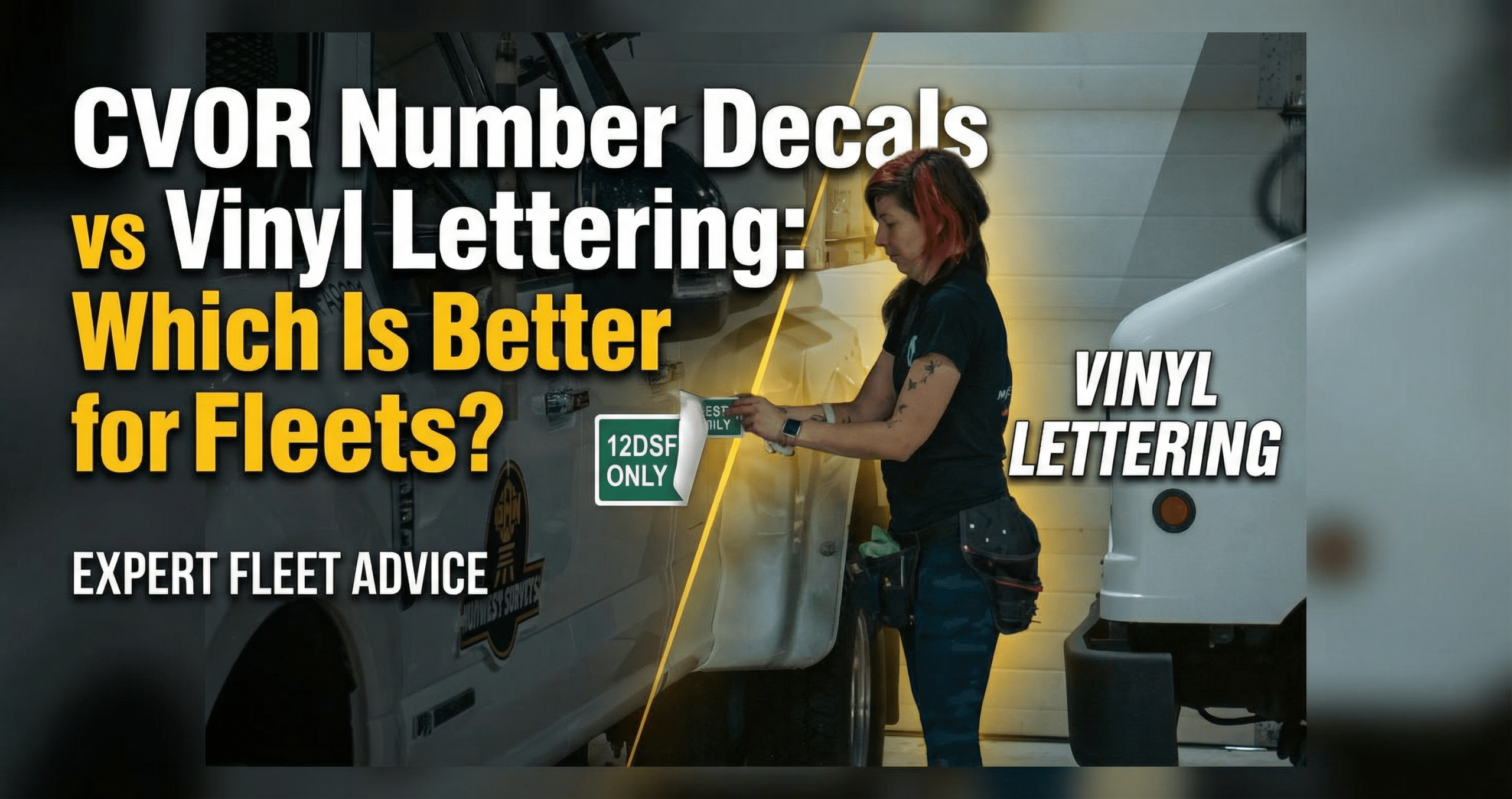
For most Ontario fleet owners, CVOR Number Decals are the simplest way to keep trucks, tractors, and trailers clearly marked without turning compliance into a design project. Vinyl lettering still has a place when you need custom spacing, exact brand matching, or a more tailored door layout, but the better option usually comes down to readability, durability, installation speed, and how often you need to reorder. In practical terms, decals are often faster to standardize across a fleet, while vinyl lettering gives you more flexibility in size, spacing, and style.
Last updated: April 2026
This guide compares both options in plain language so you can decide what makes sense for your fleet, your budget, and your day-to-day operations. You will see where each product works best, what affects wear on working vehicles, and what to confirm before you place an order in Ontario. If you want a useful primer on the production side, this overview of how vinyl lettering and decals are typically made is a helpful starting point before you compare finish, cost, and installation.
CVOR Number Decals vs vinyl lettering: what is the real difference?
The main difference is simple. CVOR Number Decals are usually made as purpose-built identification graphics with a standard layout, while vinyl lettering is a broader category that can include cut letters, numbers, and custom text arranged to fit your vehicle. For trucking companies, both can display a CVOR Number clearly, but they are generally produced and finished a little differently.
A CVOR decal is often ordered as a ready-to-apply graphic in a fixed size, font, and layout. It is usually cut from colored vinyl, weeded, masked, and supplied as a single piece for quicker installation. Vinyl lettering can use the same base material, but it is often designed more flexibly for company names, unit numbers, and longer compliance text. If you need a fast, consistent set for several trucks, a dedicated CVOR number decal is often the more streamlined option.
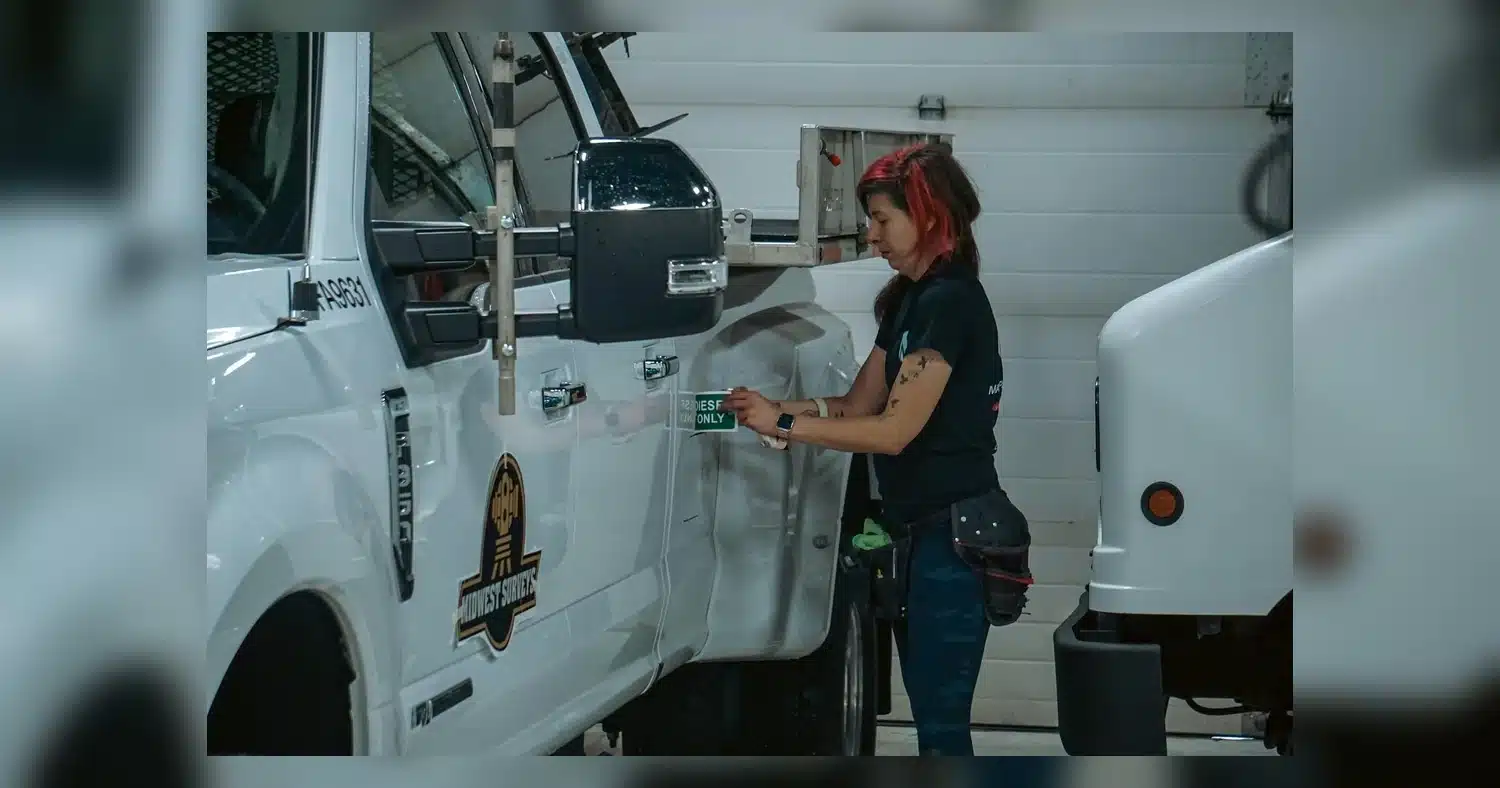
Installation is also a little different in practice. Decals are usually placed as one graphic, which reduces alignment guesswork. Vinyl lettering may involve multiple pieces, especially if the design includes separate lines, smaller numbers, or additional branding. Both are commonly installed with transfer tape, but the risk of crooked spacing is higher when the design is built from several elements.
| Feature | CVOR Number Decals | Vinyl Lettering |
|---|---|---|
| Best use | Compliance-focused vehicle ID with a standard layout | Custom text, numbers, and branded vehicle markings |
| Durability | Strong outdoor life when made with cast or premium calendared vinyl | Comparable if the same vinyl grade is used |
| Removability | Usually removable with heat, but may leave adhesive if aged | Also removable, especially if applied cleanly and not over old graphics |
| Cost | Often lower for standard sizes and repeat orders | Can cost more if the design is custom or multi-piece |
| Finish | Clean, uniform, compliance-first look | More flexibility for polished branding and vehicle-specific layouts |
In simple terms, decals are the faster and more standardized choice, while vinyl lettering gives you more design freedom. If your priority is simple compliance and consistency across a fleet, decals are often the easier buy. If you want the CVOR Number to match a broader branding system, lettering can be adapted to the rest of your truck or trailer decals and lettering.
For most business owners, the real question is not which material exists, but which setup gives you the cleanest install, the right size, and the least hassle when you need replacements later.
Ontario CVOR visibility rules that matter before you order
The safest approach is to make your CVOR Number easy to read at a glance before you place an order. That means checking placement, size, contrast, and whether the number will still be legible after months of road use, washing, and weather exposure.
In Ontario, the key issue for fleet owners is visibility. Your CVOR Number should be placed where it can be seen clearly on the vehicle, not hidden by mud flaps, equipment, lift gates, fuel tanks, or trailer hardware. If your truck or trailer has a curved body panel, a textured surface, or rivets, that can affect how cleanly the decal sits and how readable it stays. A flat, clean panel usually gives the best result.
Contrast matters just as much as placement. Dark numbers on a light surface, or light numbers on a dark surface, are easier to read from a distance. Thin strokes, decorative fonts, and low-contrast colors may look fine in a mockup but become hard to see in actual fleet use. That is why many owners choose bold block lettering for compliance markings.
Before ordering, confirm a few basics:
- The exact CVOR Number format you want printed
- Where the number will be installed on each vehicle type
- Whether the surface is flat, curved, painted, or wrapped
- The minimum size needed for clear roadside visibility
- Whether the same layout will work on trucks, tractors, and trailers
It is also smart to confirm current Ontario guidance with a sign provider before you send artwork to print. Rules and enforcement expectations can change, and a provider that works regularly with Ontario CVOR number printing requirements can help you avoid sizing or placement mistakes that turn into reprints.
If your fleet has multiple unit types, ask for a proof on the exact vehicle class you are using. What works on a straight truck may not work the same way on a day cab or a box trailer. A few minutes of checking now can save an avoidable installation problem later.
Which option holds up better on work trucks, tractors, and trailers?
For high-mileage fleet use, the better choice is usually the one made from higher-grade vinyl and installed correctly. In real-world conditions, both CVOR decals and vinyl lettering can last well, but work trucks, tractors, and trailers punish graphics differently, so durability depends more on material and placement than on the product name alone.
On vehicles that get frequent washing, premium cut vinyl tends to resist water and detergent better than economy materials. That matters if your units pass through pressure washes often or get cleaned with strong soaps in winter. Lower-grade films can shrink, crack, or lose adhesion around the edges sooner, especially if they were applied to a surface that was dusty, oily, or cold during installation.
Edge lifting is one of the biggest issues on fleet equipment. On tractors, this often shows up around seams, rivets, and compound curves. On trailers, it can happen where the decal sits near doors, hinges, or areas that flex during vibration. Once an edge starts to lift, road grime and salt can work underneath it and shorten the life of the graphic.
Winter road salt is another real test. Salt spray, slush, and repeated freeze-thaw cycles are hard on any exterior graphic. A properly applied decal on a clean, dry surface should hold up well, but high-mileage vehicles see more abrasion from plow spray, ice, and debris. That is why many fleets prefer simple, bold graphics without tiny details that can fail early.
Here is the practical ranking for fleet wear:
- Best for longevity: premium cast or high-performance calendared vinyl
- Best for easy replacement: standardized CVOR Number Decals
- Most vulnerable areas: rivets, seams, door edges, and highly curved panels
If your trucks are washed often and run year-round, ask for a material spec that matches fleet use rather than a basic indoor-outdoor film. For many operators, that means a tougher vinyl with strong adhesive and clean edge cutting, plus a layout that avoids overworking the decal on difficult surfaces. In mixed fleets, the same approach should be adapted for tractors and trailers separately so the graphics wear evenly across units.
What drives pricing for CVOR Number Decals and vinyl lettering?
The main price drivers are quantity, material quality, design complexity, installation method, and how closely the graphics must match the rest of your fleet. For most CVOR Number Decals, a simple one-colour cut vinyl job is the most cost-efficient option, while custom fleet graphics, specialty films, and on-site install all raise the total.
Quantity changes the per-unit cost
Single-truck orders usually cost more per decal because the setup, proofing, and cutting work are spread across fewer units. Once trucking companies order multiple tractors or trailers at the same time, the per-decal price often drops. That matters when you are standardizing numbers across a fleet and want the same look on every unit.
Material choice affects durability and price
Economy calendared vinyl is typically less expensive up front, but premium cast vinyl, reflective film, or higher-tack adhesive can cost more because they last longer and perform better on curved panels, heavy-use doors, and outdoor exposure. If the decals must hold up through frequent washing, winter salt, and long highway runs, paying more for better film can save replacement costs later.
Design and matching requirements add labour
Simple CVOR Number lettering is quicker to produce than layered logos, multiple colors, or graphics that must align with existing fleet branding. Matching font style, color codes, and spacing to a trailer decal set or a corporate door layout also adds design time. If your fleet already uses a standard format, reorders are usually faster and less expensive because the files are already built.
Install method and urgency also matter
Shop installation, mobile installation, or customer-applied decals all affect pricing. On-site application costs more because of labour, travel, and scheduling. Rush orders can also increase the total if the shop needs to reorder material, rework proofs quickly, or shift production ahead of other jobs. For comparison, the same price factors often apply to trailer decals and lettering when a fleet wants matching side panels and identification marks.
One useful way to control cost is to approve a standard spec for size, color, and finish so every future order can be repeated without new setup work. Industry comparisons of vinyl lettering versus decal production also show that simpler cut vinyl jobs are usually faster and more affordable than printed, multi-step graphics.
How turnaround time changes for single trucks versus fleet rollouts
Single-truck orders are usually faster to quote and produce, but fleet rollouts can be quicker overall once the design is approved. The biggest time variables are proofing, production queue, shipping, and installation windows. For trucking companies, the real goal is to avoid downtime while still keeping every CVOR Number Decal consistent.
Single truck: faster approval, but less batching efficiency
A one-unit order often moves quickly through proofing because there are fewer specs to confirm. If the size, color, and placement are standard, production can start as soon as the proof is approved. That said, a single truck may not benefit from batching, so the job can still sit behind other production work if the shop is busy.
Fleet rollout: longer planning, smoother repeatability
When you are branding multiple tractors or trailers, there is usually an initial design and approval stage that takes longer. Measurements, photo mockups, and placement review take extra time, especially if the fleet includes different cab styles or trailer lengths. After that first unit is approved, the remaining decals are much faster to duplicate, which makes rollouts efficient once the system is set.
Shipping and install windows should match dispatch schedules
If the trucks are on the road daily, the ideal window is often an off-peak yard stop, weekend service slot, or a scheduled maintenance day. Production may be complete, but shipping and installation still need to line up with dispatch. A decal that arrives two days early is not useful if the unit is unavailable for install, while a late delivery can push the whole rollout back.
Reorders are usually the fastest jobs
Once artwork and dimensions are on file, repeat orders for CVOR Number Decals can move much faster than a first-time order. The shop already has the approved format, so there is less back-and-forth and fewer production delays. That same speed advantage often applies to standardized USDOT number decals and other compliance graphics.
For planning purposes, ask for proof approval timing, estimated production time, and whether the shop can stage multiple units for one delivery or install day. A clear schedule helps reduce truck downtime and keeps your fleet rollout aligned with route commitments and yard access.
Common mistakes that cause reorders, delays, or poor first impressions
The most common problems are wrong sizing, poor color contrast, bad surface prep, and choosing a material that does not suit the vehicle. These mistakes can lead to reprints, failed installs, and graphics that look unprofessional the moment the truck leaves the yard.
Ordering the wrong size or placement
Many buyers guess instead of measuring the exact door, fairing, or trailer space. That can lead to a CVOR Number Decal that is too small to read at a distance or too large for the panel it was meant to fit. Before approval, measure the flat area, check for seams or handles, and confirm that the number will be visible from the expected viewing distance.
Choosing low-contrast colors
Low contrast is one of the easiest ways to fail on visibility and first impression. Dark gray on black, white on pale silver, or red on a busy reflective background can disappear fast in daylight, rain, or winter grime. Trucking companies should always test the chosen color against the actual vehicle paint or trailer finish, not just on a white proof screen.
Skipping proper surface prep
Decals do not bond well to dusty, greasy, waxed, or freshly painted surfaces. If the installer skips cleaning or applies vinyl to a cold panel, edges can lift early and the lettering may trap bubbles. A clean, dry, temperature-appropriate surface is essential for a strong bond and a neat finish.
Using the wrong material for the vehicle
A basic vinyl film may work on a flat door, but curved cabs, textured panels, and exposed trailer areas may need a higher-performance adhesive or film. If the material does not match the surface, the decal can wrinkle, lift, or wear unevenly. For fleets that also need trailer identification, material selection matters even more on large exposure areas like trailer decals and lettering.
Rushing without checking the proof
A common cause of reorders is approving artwork too quickly. A proof should confirm spacing, letter order, number format, and the exact placement of the CVOR Number. If the shop also produces companion decals such as NSC number decals, it is worth making sure every compliance graphic follows the same layout standard before production starts.
Finally, do not assume every vinyl product is built the same way. A simple mistake in finish, adhesive, or sizing can turn a low-cost order into a repeat job, which costs more time and creates a poor impression on the road and at the dock.
How to choose the best solution for your trucking company
The best choice for most Ontario fleets comes down to one practical question: do you need the fastest, lowest-friction compliance option, or do you need a more controlled branded look across multiple vehicles? If your priority is simple ordering, fast installation, and easy replacement, CVOR Number Decals are usually the safer fit. If appearance standards are tighter and you want every truck to match existing door graphics exactly, vinyl lettering is often the better long-term system.
Start with budget and fleet size
For one truck or a small owner-operator setup, keep the decision simple. Choose the format that gets you compliant quickly without creating design work you do not need. For growing fleets, think beyond the first truck and ask how easily the same spec can be repeated across 5, 25, or 100 units.
- Lowest admin burden: pre-sized decals with consistent formatting
- Best for custom visual alignment with existing branding: vinyl lettering
- Best for mixed fleets with tractors, straight trucks, and service units: standardize one spec and reorder from that file every time
Think about brand consistency
If your trucks already carry logo decals, unit numbers, and company lettering in a set layout, your compliance markings should look like part of the same system. Many fleets prefer lettering when visual consistency matters because cut vinyl lettering uses individually cut characters instead of a printed background, which helps create a clean, integrated finish.
If branding is secondary and readability is the main goal, decals are usually easier to standardize and approve internally.
Match the choice to vehicle turnover
If you rotate tractors often, lease equipment, or regularly add and retire trucks, choose the option that is easiest to reorder and replace without redesign. High-turnover fleets generally benefit from simple production specs, repeatable placement notes, and minimal approval steps.
Ask your supplier for a saved fleet standard that includes size, color, placement, and door-side spacing. That reduces rework when a replacement truck arrives with slightly different panel dimensions.
Bundle compliance items in one order
If your operation runs beyond Ontario, this is the point where ordering strategy matters. Interprovincial carriers may want a matching NSC number decal added at the same time. Carriers crossing into the U.S. should review whether USDOT number decals should be produced in the same material, color, and layout. If trailers also need identification, bundle trailer graphics in the same production run so the whole unit looks coordinated.
Use this decision checklist
- Choose decals if speed, simplicity, and repeat ordering matter most.
- Choose lettering if your fleet image standards are strict and door layouts must match existing branding.
- Standardize one spec if you have multiple vehicle types or frequent turnover.
- Bundle CVOR with NSC, USDOT, or trailer identifiers when one install visit can cover everything.
- Approve one master proof for all future trucks to avoid inconsistent markings across the fleet.
If you want the simplest path, start by confirming the exact number, placement, size, and contrast you need, then choose the product that fits how your vehicles are actually used. For many fleets, standardized CVOR number decal options make ordering and reordering easier, while custom vinyl lettering can be worth it when brand consistency is the priority. A quick proof review before production can prevent the most common delays, reorders, and compliance headaches.
Related Products and Services
If you are planning a similar project, these related options may help.
Helpful External Resources
These sources provide supporting background and additional context.
Are CVOR Number Decals required on commercial vehicles in Ontario?
If your vehicle falls under Ontario’s commercial marking rules, the CVOR number must be displayed clearly on the exterior, usually on both sides. The exact requirements can vary by vehicle class and weight, so confirm the latest MTO guidance before you order.
Is vinyl lettering better than decals for long-term fleet branding?
For long-term fleet branding, vinyl lettering is often the better choice when you need a more custom look, exact spacing, or a layout that matches existing door graphics. CVOR Number Decals are usually better when your priority is fast ordering, simple compliance, and easy reordering across multiple vehicles.
How long do CVOR Number Decals usually last?
Quality CVOR Number Decals typically last several years, often around 3 to 7 years, depending on the vinyl grade, sun exposure, weather, washing habits, and how well they are installed.
What affects the price of a fleet order?
Pricing depends on the number of vehicles, decal size, material choice, color count, whether installation is included, and how much design or setup work is needed. Standardized fleet layouts usually cost less per unit than fully custom orders.
What affects turnaround time for CVOR Number Decals?
Turnaround depends on proof approval, file readiness, order size, and the current production schedule. Simple repeat orders can be fast, while larger fleet runs or jobs needing design cleanup and installation usually take longer.
What file format should I send for the best results?
Vector files such as AI, EPS, or PDF usually give the cleanest results for sharp lettering and accurate sizing. If you only have a raster file like JPG or PNG, send the highest resolution version available so it can be reviewed before production.
Get a Free Quote Today
Contact us at +1-(416) 288-8661 or Email us at info@Brandingcentres.com and let's get started.