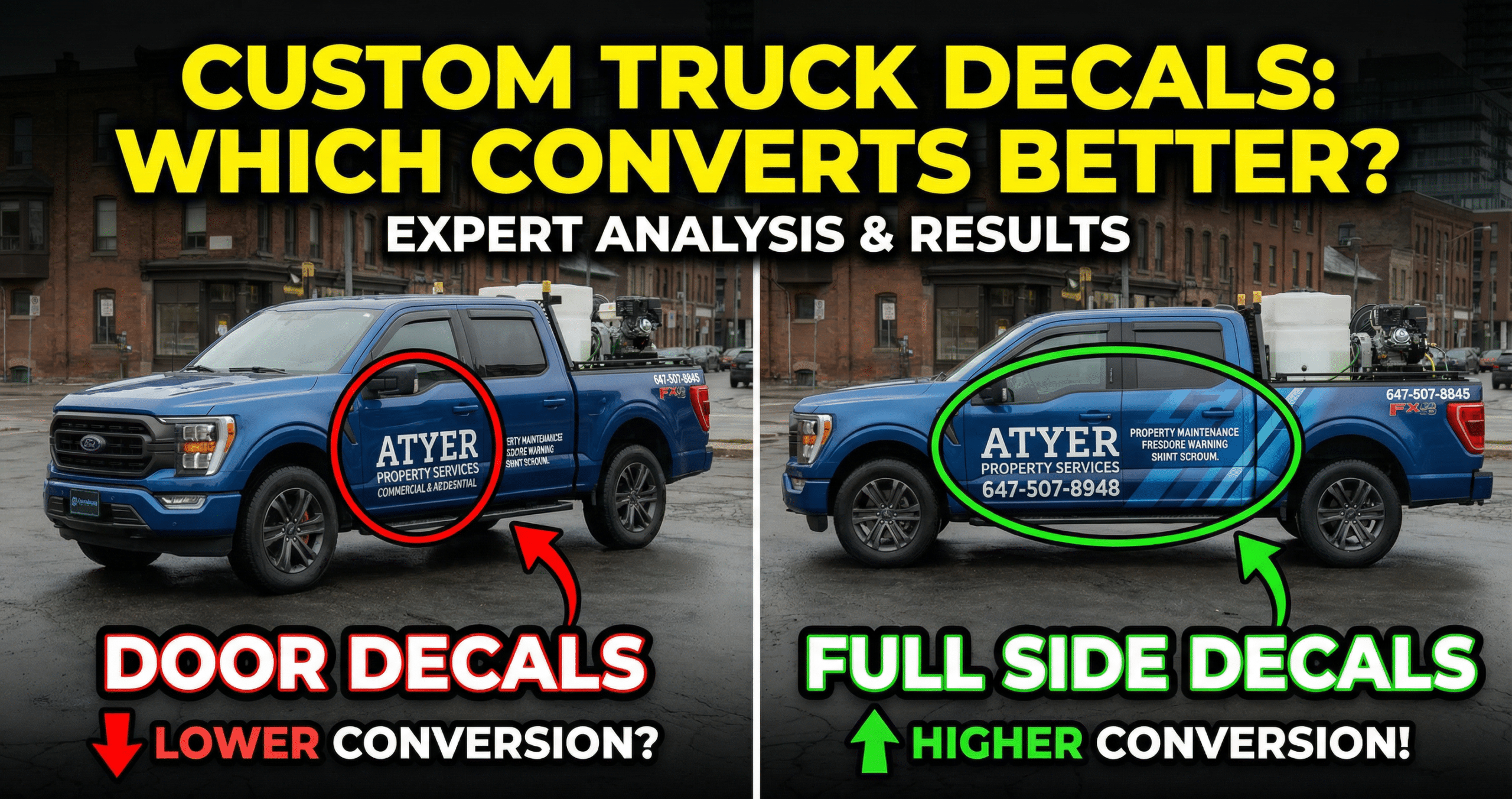
Custom Truck Decals are one of the most practical ways for business owners to turn every stop, route, and jobsite into local advertising, but choosing between door decals and full side decals can affect how many people notice your brand and how often they act on it. For a helpful overview of the tradeoffs, this comparison of custom decals versus full wraps explains how coverage, visibility, and budget influence results. If you want a starting point for vehicle-specific options, truck decals and lettering solutions can help you match the right format to your goals.
Last updated: March 2026
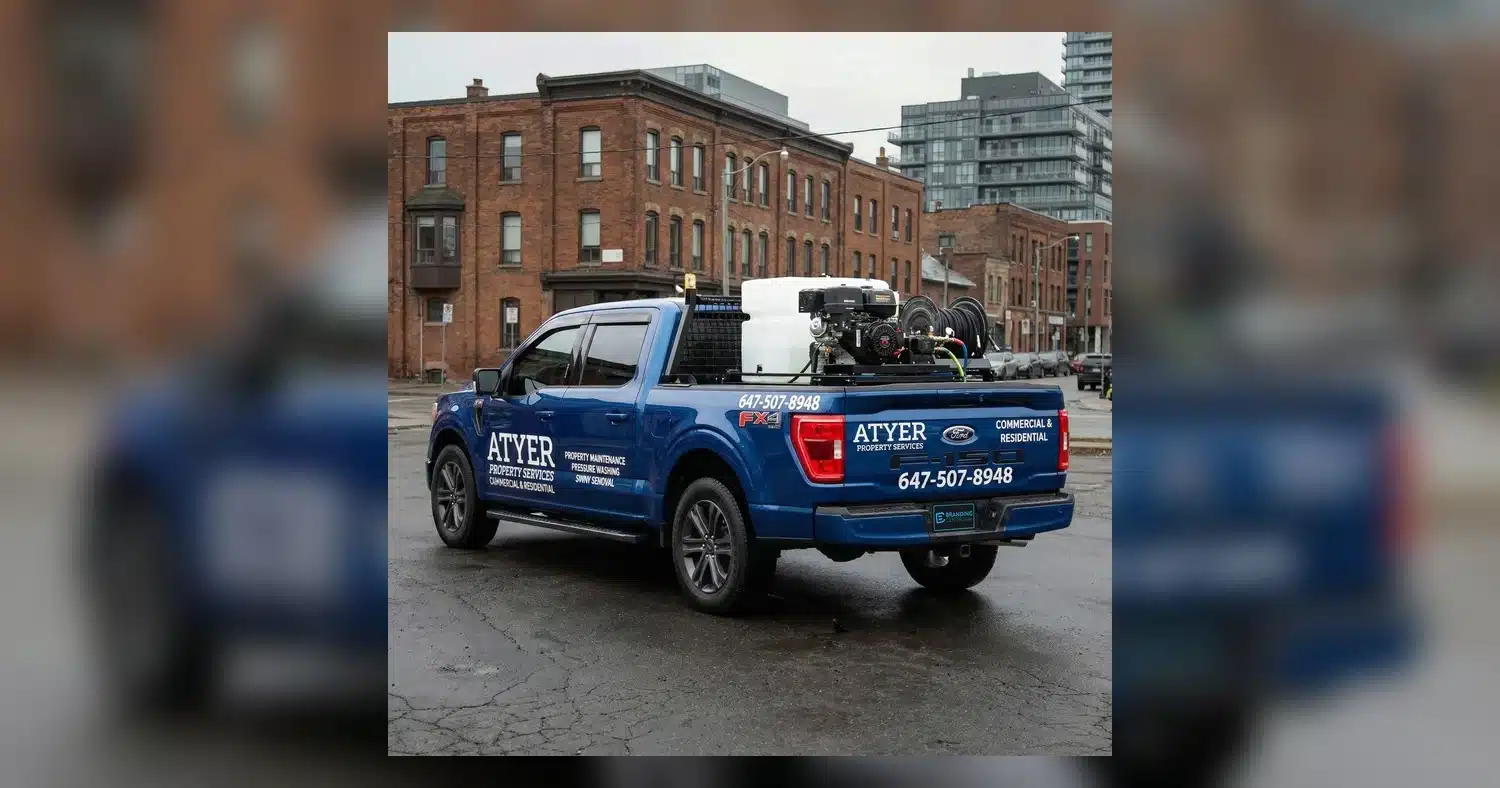
In this guide, we will compare truck door decals and full side decals from a conversion standpoint, then break down design, placement, cost, durability, and ROI so you can choose the option that best supports calls, website visits, and local brand recognition.
Why truck-side advertising still works for local businesses
For local businesses, truck-side advertising works because it turns every trip into repeated neighborhood visibility. A truck moving through residential streets, job sites, commercial corridors, and parking lots can create hundreds or even thousands of impressions in a week, especially when it is used daily in the same service area. Unlike many digital ads, the message is tied to real-world presence, which helps people remember the brand when they need a service later.
That visibility matters because local buyers often choose the company they recognize first. A wrapped or lettered truck signals that the business is established, active, and operating nearby. It also creates a sense of legitimacy that can be hard to match with short-term online ads. For contractors, home service companies, delivery businesses, and trades, a branded vehicle can function like a moving storefront.
Why repeated exposure matters
People rarely call the first business they see once. They notice a name on the road, then again at a job site, then again outside a school or hardware store. That repetition builds familiarity, and familiarity lowers the friction to inquire. In local marketing, this is often the difference between being remembered and being ignored.
Truck advertising also works well because the audience is already regional. A service truck driving within a tight service radius is reaching people who can actually buy. If your business serves Toronto and nearby areas, branded vehicles help reinforce your presence where customers live and work, which is one reason many companies pair truck decals and lettering with other local marketing channels.
Visibility and trust drive local customer acquisition
Local customer acquisition depends on being noticed and trusted fast. A clean, readable truck graphic tells people what you do, where you operate, and how to reach you. It can also reduce the cost of acquiring attention compared with paid ads that disappear as soon as the budget stops.
One reason this format endures is that well-executed custom truck decals can generate ongoing brand exposure without recurring media spend. For small and midsize businesses, that makes each vehicle an asset rather than a one-time promotion.
How Custom Truck Decals improve conversions and local reach
Custom Truck Decals do more than decorate a vehicle. When designed correctly, they help the right audience recognize the business, understand the offer, and take the next step. The conversion path is simple: someone sees the truck, reads the name or service, remembers it later, and contacts the company when a need comes up.
That matters because vehicle graphics are often viewed in motion or from a distance, so the best-performing designs focus on fast comprehension. Strong contrast, a clear service message, and a visible phone number or website can all improve response. Businesses that use truck decals as part of a broader local branding strategy often see better recall than those relying on a plain vehicle or cluttered artwork.
What drives response
Real-world response is usually influenced by three things: clarity, relevance, and repetition. If the truck says exactly what the company does, nearby prospects are more likely to remember it. If it appears consistently in neighborhoods where the business works, the audience is more likely to trust it. If the design is easy to read at traffic speed, more people absorb the message.
- Clarity: one primary service or value proposition
- Relevance: local phone number, website, or service area
- Repetition: frequent travel in the same neighborhoods
For many buyers, the truck is the first point of contact. That is why businesses offering truck full wraps or partial graphics often build the design around contact information and a short message instead of using too many visual elements.
Audience cues that improve conversions
Local audiences respond to cues that signal professionalism and proximity. A branded vehicle with consistent colors, a clean logo, and a specific service category can make a business feel more dependable than a generic van or unmarked pickup. If the customer is comparing multiple providers, that familiarity can tip the decision.
Custom Truck Decals also support digital conversions. A memorable truck message can prompt web searches, website visits, and direct calls after a sighting. For businesses running fleet marketing or service-area campaigns, those extra touchpoints help bridge offline awareness with online action.
When the audience sees the same brand on the road and in search results, the message feels more credible. That is why many companies treat truck graphics as a conversion tool, not just a branding expense.
Design, placement, and messaging best practices for truck door decals
Truck door decals work best when they are built for quick reading. Most viewers only have a few seconds to absorb the message, so the design should prioritize legibility over decoration. The goal is not to show everything the business can do. The goal is to help a driver, pedestrian, or property owner remember the brand and contact it later.
Keep the design simple and readable
Use high contrast between the background and text, and avoid thin fonts that disappear at a distance. Large lettering, clean logos, and a limited color palette usually perform better than busy layouts. If the truck is parked on a street or in a driveway, viewers should understand the business at a glance.
Short copy is easier to process. In most cases, the best-performing truck door decals include:
- Business name
- Primary service or trade
- Phone number or website
- Optional service area such as Toronto or the GTA
Placement matters
Door decals should sit where eyes naturally land, typically on the front and rear doors or centered on the main side panel. This keeps the message visible when the truck is parked and when it passes in traffic. If the vehicle is part of a service fleet, matching placement across all trucks creates a consistent look that improves recognition.
For businesses comparing vehicle graphic formats, van decals and lettering can follow the same readability rules, especially when the vehicle is used across busy urban routes.
CTA recommendations that increase response
Include one clear action, such as a phone number, website, or short call to action like “Call for a quote.” Do not crowd the design with multiple offers, social handles, or long taglines. A single CTA gives the viewer a clear next move.
Useful messaging usually follows this pattern:
- Who you are
- What you do
- How to contact you
Keep the text large enough to read from a moving car, and test the layout from a distance before printing. If the truck is used for premium branding, combine the contact info with a simple value statement instead of a paragraph of services. That approach keeps the design clean while still supporting calls and web visits.
Head-to-head comparison: door decals versus full side decals
Door decals and full side decals both support local marketing, but they solve different business goals. Door decals are usually the practical choice for companies that want affordable visibility and quick installation. Full side decals create a larger visual footprint and can deliver stronger brand presence, especially for businesses that depend on impression volume.
The right choice depends on budget, how long the truck stays on the road, and how much of the vehicle should be used for messaging. The comparison below can help you match the format to the outcome you want.
| Factor | Door Decals | Full Side Decals | Best Fit |
|---|---|---|---|
| Visibility | Strong at close range and when parked | Much larger presence from the road and in traffic | Full side decals for maximum brand exposure |
| Cost | Lower upfront investment | Higher material and production cost | Door decals for smaller budgets |
| Installation time | Faster to produce and apply | Longer install due to larger coverage area | Door decals when downtime needs to stay minimal |
| Maintenance | Easier to replace if contact info changes | More involved if the design or branding changes | Door decals for businesses that update often |
| Durability | Good durability with proper material and care | Good durability, but larger surface means more visible wear over time | Both options work well with quality vinyl |
| Typical use cases | Service trucks, small fleets, contractor branding | High-visibility branding, premium local marketing, larger fleets | Choose based on awareness goals and budget |
In practical terms, door decals are often the best starting point for businesses that want a professional look without committing to a full graphics package. They are also easier to refresh when a phone number, website, or service area changes. Full side decals, by contrast, are better when the vehicle is central to branding and the business wants the truck itself to act like a mobile billboard.
If your goal is broad recognition and you want the vehicle to stand out in dense traffic, full side coverage usually wins. If your goal is cost control, flexibility, and clear service identification, door decals are often the smarter option. Many companies compare these choices alongside custom decals versus full wraps before deciding which format fits their route patterns and marketing budget.
Cost, installation, and maintenance: budgeting for decals or full wraps
Budgeting for truck graphics starts with understanding that Custom Truck Decals usually cost less upfront than full side graphics. Pricing varies by vehicle size, design complexity, material quality, and whether you are applying one truck or an entire fleet. In most cases, decals are a more accessible entry point for small businesses, while full wraps are a larger branding investment with broader coverage.
Typical cost range
- Door decals or partial graphics: Often the lowest-cost option, especially for simple logos, contact details, and spot branding.
- Full side decals: Mid-range pricing, because they cover more surface area and require more material and labor.
- Full wraps: Highest initial cost, since they use more vinyl, more design time, and more installation time. A full wrap also benefits from a dedicated installation environment, such as the process used for truck full wraps.
Installation and downtime
Simple decal installs can often be completed quickly, sometimes within a few hours. Larger side graphics take longer, and full wraps may require a full day or more depending on vehicle size and prep work. For businesses that keep trucks on the road, shorter install times can mean less lost service time and lower operational disruption.
Maintenance and repair
Decals are easier to replace if a panel gets scratched, faded, or damaged. That makes them a practical choice for vehicles that work in tight job sites, heavy traffic, or harsh weather. Full wraps can also be repaired, but replacement is usually more involved because larger sections may need to be reprinted and matched carefully. Industry sources on fleet decals versus full wraps note that maintenance needs should factor into the total cost, not just the initial install.
Total cost of ownership
When comparing options, think beyond the invoice. Consider design revisions, install labor, downtime, replacement panels, and how long the graphics will stay visually strong. A lower-cost decal setup can deliver strong value for local service businesses, while a full wrap may make sense when maximum visibility justifies the higher spend.
Selecting the best solution for fleets, single vehicles, and campaign types
The right choice depends on how many vehicles you have, how long the campaign will run, where the vehicles operate, and how much branding space you need. In many cases, van decals and truck decals are ideal when you want flexibility, while larger wraps are better when visual impact is the priority. If you are weighing truck decals and lettering against full coverage, use the rules below to narrow the choice.
Use decals when:
- You have a single vehicle or a small fleet and want a lower upfront investment.
- Your message is simple, such as a logo, phone number, web address, and service list.
- The campaign is long-term and you want graphics that can be updated piece by piece.
- Your service area is local and repeat visibility matters more than dramatic design coverage.
Use full side decals or wraps when:
- You run a larger fleet and want a consistent brand look across multiple trucks.
- You operate in a competitive area where bold visuals help your vehicles stand out.
- You are launching a new brand, promotion, or seasonal campaign that needs maximum attention.
- You want to use the vehicle surface as a mobile billboard for broad market coverage.
Match the graphic to the campaign
Short promotions often work well with decals because they are faster to install and easier to change. For example, a contractor advertising a limited-time service area or seasonal offer may not need full coverage. Long-term brand building often benefits from larger graphics because they create stronger recognition on the road.
Geography also matters. If your trucks spend time in dense urban areas, bold side coverage can generate more exposure at intersections and traffic stops. If they move mostly between job sites, decals may be enough to build awareness without overspending. For some businesses, such as local service companies and smaller fleets, a balanced approach is best: start with decals, then expand to larger graphics as the campaign proves itself.
How to measure performance and calculate ROI from truck advertising
Truck advertising can be effective, but business owners still need a simple way to measure results. The goal is to connect vehicle exposure to real business outcomes like calls, quote requests, and booked jobs. Since mobile ads do not work like digital ads, tracking is usually based on response signals and cost efficiency rather than direct clicks. Articles on custom truck decal benefits also emphasize visibility and lead generation as the main performance drivers.
What to track
- Impressions: Estimate how many people see the vehicle in a day, week, or month based on routes, traffic volume, and parking locations.
- Lead sources: Use a dedicated phone number, landing page, or promo code on the truck graphics.
- Call volume: Track inbound calls tied to the campaign period.
- Form fills or quote requests: Measure leads coming from a custom URL or QR code.
- Cost per lead: Divide total campaign cost by the number of leads generated.
Simple ROI formula
A practical way to estimate return is:
ROI = (Revenue from leads minus total graphic cost) / total graphic cost
If a decal or wrap costs $2,000 and produces $10,000 in tracked revenue, the return is strong. You can also use a lead-based version:
Cost per lead = total cost / total leads
This helps compare truck advertising with other channels such as paid search or local print ads.
Improving measurement accuracy
Use one phone number for the campaign, one page for the offer, and one clear call to action. Review results monthly, not just once at launch, because truck graphics build awareness over time. If you run more than one vehicle type, compare performance across routes and geography. A truck with vehicle decals in a busy service corridor may produce a different lead volume than a truck parked overnight in a suburban depot.
For the most useful ROI view, combine measurable leads with softer brand gains such as recall and repeat exposure. That gives business owners a clearer picture of whether truck advertising is generating both awareness and revenue.
For many business owners, the best choice comes down to how much visibility you need, how long the vehicle will stay branded, and how quickly you want to recover the investment. If you want a simple, effective way to promote your company on the road, start with the option that fits your routes, budget, and campaign goals. Explore truck decal options to find the right fit for your fleet.
Related Products and Services
If you are planning a similar project, these related options may help.
Helpful External Resources
These sources provide supporting background and additional context.
Which converts better for small businesses: truck door decals or full side wraps?
For most small businesses, Custom Truck Decals on the doors convert well because they are affordable, easy to read in traffic, and ideal for branding contact details. Full side wraps usually generate more impressions and stronger visual impact, which can convert better if you need maximum local visibility and have a larger budget.
How long do Custom Truck Decals typically last and how do I maintain them?
High-quality Custom Truck Decals often last 3 to 7 years, depending on material quality, sun exposure, and care. To help them last longer, wash gently with mild soap and water, avoid pressure washing at close range, and do not use abrasive cleaners or tools on the graphics.
Can I apply decals to any truck surface and will they damage paint?
Custom Truck Decals adhere best to smooth, clean, painted metal or factory-finished surfaces. They are generally safe for intact automotive paint when installed and removed correctly, but they may not bond well to rusty, heavily textured, or freshly painted surfaces that have not fully cured.
What is the typical cost difference between door decals and a full side wrap?
Door decals are usually much less expensive than a full side wrap because they use less material and take less installation time. A full side wrap can cost several times more, but it also covers more area and delivers a larger advertising presence.
Are Custom Truck Decals a good option if I want a simple, professional look?
Yes. Custom Truck Decals are a strong choice if you want clean branding, a logo, business name, and phone number without covering the entire vehicle. They are popular with contractors, service businesses, and fleets that want a polished look at a lower cost.
Get a Free Quote Today
Contact us at +1-(416) 288-8661 or Email us at info@Brandingcentres.com and let's get started.