If you are searching for the best printing near Humber College, the fastest answer is this: campus printing is usually the best choice for basic class documents and simple short-run jobs, while a nearby print shop is usually the better option for flyers, posters, presentation packages, branded materials, and anything that needs stronger finishing, proofing, or flexible turnaround. For students, campus organizers, and local business owners, the right choice depends less on the lowest price and more on deadline, quantity, print quality, file support, and pickup convenience.
Last updated: April 2026
Around Humber College North and the University of Guelph-Humber, that distinction matters. Campus printing is convenient when your file is already prepared and you need straightforward output close to class or campus activity. Guelph-Humber students, for example, have access to web print and on-campus release printing, which makes campus printing practical for standard academic use. But once you need larger quantities, heavier stock, accurate color, binding, signage, or polished marketing materials, a nearby print shop often provides better control and better overall value.
This guide explains when to use campus printing, when to use a nearby print shop, and how to choose the best option for handouts, event collateral, student campaigns, and local business print jobs without wasting time or money on reprints.
What makes the best printing near Humber College?
The best printing near Humber College is the option that balances speed, file support, print quality, and convenient pickup with a fair total cost.
For students, event organizers, and nearby businesses, the best choice is usually not the closest printer. It is the one that can handle your file correctly, produce the finish you want, and have the order ready when you actually need it.
What buyers should look for
- Location and access: Close enough for a quick drop-off or pickup, especially if you are on a deadline or carrying several boxes.
- Turnaround time: Same-day or next-day service matters for class handouts, event signage, and last-minute marketing materials.
- File support: Good print shops can work with PDF, Canva exports, high-resolution images, mixed-size documents, and bleed settings without making you troubleshoot alone.
- Print quality: Crisp text, accurate color, clean cuts, and consistent duplexing matter more than a low base price if the job is client-facing.
- Pickup convenience: Flexible hours, easy parking, and simple order pickup reduce stress for busy schedules.
- Total value: Look at the full cost, including rush fees, binding, finishing, reprints, and the time saved when files are checked properly.
For local businesses, the best printing near Humber College often means a nearby print shop that can handle branded flyers, menus, posters, and presentation packages without constant back-and-forth. For student groups, it may mean a provider that keeps costs predictable while catching file issues before they become expensive mistakes.
If you are comparing options, search for service pages that clearly explain academic and business printing, turnaround windows, and supported formats. Humber’s own academic printing information is a useful starting point for understanding campus-side services.
Campus printing at Humber and Guelph-Humber: strengths and limits
Campus printing is best for routine academic work, quick document output, and convenience during the school day.
It works well when you need to print essays, readings, handouts, slides, lab material, or basic black-and-white jobs without leaving campus. For many students, that makes it the fastest way to get a document in hand or into a binder before class.
Where campus printing works well
- Academic documents: Essays, reports, readings, forms, and simple presentations.
- On-campus convenience: Easy access between classes, especially when you only need a few pages or one copy set.
- Standard formats: PDF-based jobs that do not need special finishing.
- Predictable campus workflow: Useful for students who already use campus systems and know the pickup process.
Where campus printing can fall short
Campus printing is usually more limited when the job becomes larger, more visual, or more brand-sensitive. A poster run, event package, promotional booklet, or multi-piece campaign often needs more flexibility than a basic academic printer can provide.
Limits can include fewer paper choices, fewer finishing options, less help with custom file setup, and stricter rules around size or volume. If you need coated stock, heavier cover paper, binding, folding, lamination, stapling, or consistent color across multiple copies, a nearby print shop may be the better fit.
That matters for student clubs, conference organizers, and local businesses producing materials that need to look polished. A nearby print shop can often handle larger quantities, make layout corrections, and support branded pieces more effectively than a campus-only workflow.
For students at Humber and Guelph-Humber, campus printing remains a strong convenience option. For anything that has to look professional, arrive in volume, or support an event deadline, it is worth comparing printing options with a nearby provider too. Guelph-Humber’s campus printing service details show how these academic systems are typically designed around student use cases.
Campus printing vs nearby print shop: a practical side-by-side comparison
If you want the fastest way to compare printing options, start with the job type. Campus printing is usually best for simple academic output, while a nearby print shop is better for larger, branded, or polished materials.
The table below gives a quick side-by-side view of the two options so you can match the service to the job instead of guessing based on price alone.
| Comparison point | Campus printing | Nearby print shop | Best fit |
|---|---|---|---|
| Use case | Essays, readings, forms, class handouts, basic presentations | Flyers, posters, brochures, event signage, menus, branded packets | Campus for academic basics; print shop for marketing and events |
| Speed | Convenient for same-day student needs when you are already on campus | Often fast, with more ability to handle rush or scheduled pickup orders | Campus for quick in-between-class jobs; print shop for deadline-driven bulk orders |
| Flexibility | Usually limited to standard sizes, common file types, and basic output settings | More flexible with custom sizes, mixed files, special instructions, and volume | Print shop when the job needs file help or custom handling |
| Finish options | Often minimal finishing, with fewer choices for binding, folding, or premium stock | Broader options such as trimming, folding, stapling, lamination, and heavier paper | Print shop for polished handouts, proposal packages, and promotional pieces |
| Who it serves best | Students printing for class and routine academic work | Student groups, campus organizers, local businesses, and anyone needing branded output | Campus for personal academic needs; print shop for collaborative or commercial work |
Quick decision rule
- Choose campus printing if the job is small, standard, and tied to a class deadline.
- Choose a nearby print shop if the job needs better paper, color accuracy, finishing, or order support.
- Choose a nearby print shop first for anything that will be handed to clients, sponsors, or event attendees.
A practical example: printing three pages of lecture notes is a campus-printing task. Printing 200 event flyers, a welcome banner, and matching table cards is usually a nearby print shop job. That simple split helps students and businesses avoid overpaying for features they do not need, while still getting the right quality when presentation matters.
How to choose the right print option for your file, deadline, and budget
The best printing near Humber College depends on what you are printing, how fast you need it, and how polished it has to look. For simple black-and-white handouts, campus printing is usually the fastest and most economical. For color-heavy pieces, binding, oversized prints, or anything that needs a proof before release, a nearby print shop often gives you more control.
Start with the file type and finish requirement
If your file is a basic PDF, single-sided handout, or worksheet, campus printing is usually the simplest option. It is a strong fit for class packets, forms, and short-run student prints. If your job includes multi-page booklets, saddle stitching, coil binding, heavy covers, or oversized posters, a nearby print shop is often the better match because it can handle more finishing choices.
Use quantity as a decision filter
- Low quantity: 1 to 20 pages, or a small number of copies, often makes campus printing easier and cheaper.
- Medium quantity: 20 to 200 pages, especially if color is involved, may be more cost-effective at a nearby print shop.
- High quantity: Large handout runs, event packages, and repeated prints usually benefit from commercial-grade equipment and batch pricing.
Match color needs to the right provider
If your content is mostly text, black-and-white printing is usually the best value. If you need charts, branded flyers, photos, or marketing collateral, compare the color quality and per-page pricing carefully. A nearby print shop can often produce more consistent color across a larger run, which matters for student recruitment pieces, event signage, and business handouts.
Check proofing and approval needs early
If the document must be reviewed by a supervisor, professor, or client before the full run, a nearby print shop is often safer because it can supply a proof copy and make adjustments before final production. That is especially important for business cards, posters, menus, and event materials where layout errors are expensive to fix.
When to lean campus, when to lean local
- Choose campus printing for quick, low-complexity jobs.
- Choose a nearby print shop for color accuracy, binding, large format, and proof-based jobs.
- Choose a print shop if your file uses special paper, unusual sizes, or needs trimming and finishing beyond basic output.
For students at Humber and Guelph-Humber, it also helps to confirm current campus services and file requirements before you submit. The Humber academic printing guide is a useful starting point when you want to compare options quickly.
What actually drives print pricing around Humber College
Print quotes around Humber College are usually driven by six things: color usage, page count, paper stock, finishing, turnaround speed, and setup work. If you understand those inputs, it becomes much easier to compare a campus print job with a nearby print shop and see where the price is actually coming from.
Color coverage matters more than people expect
Color printing is not just about whether a page is in color. Full-page photos, dark backgrounds, brand blocks, and heavy graphics use more toner or ink than a page with one logo and a few accents. A flyer with 80 percent color coverage can cost noticeably more than a document that uses color only for headings and charts.
Page count and copies multiply the total
A 10-page report printed once is a simple order. The same report printed for 40 people becomes a major cost driver because the total sheet count rises fast. Duplex printing can reduce paper use, but it does not always cut total print cost in half because labor, setup, and finishing still matter.
Paper stock changes the quote quickly
Standard 20 lb or 24 lb paper is usually the baseline. Heavier stocks, coated stocks, cardstock, and textured papers cost more because they are purchased at higher rates and may require slower machine settings. If your project is a leave-behind, menu, cover sheet, or poster handout, paper choice may change the final price more than the number of pages.
Finishing adds value and cost
- Stapling or folding: usually low-cost, but still a line item on some quotes.
- Binding: coil, comb, or perfect binding raises the price because it adds labor and materials.
- Cutting, trimming, and lamination: common for marketing and event pieces, but each step adds time and cost.
- Large format mounting: often priced separately from standard sheets.
Rush jobs and reprints can change everything
When you need same-day or next-day output, you may pay a rush fee for priority handling. Reprints are another hidden cost if your file has errors, missed bleeds, or a wrong page count. That is why proof review matters before you approve a large run.
Setup costs are real, even for small orders
Some jobs require file checks, color adjustments, imposition, or custom finishing setup. That setup time is often baked into the quote. A nearby print shop may charge more upfront than campus printing, but it can also save money when you need repeated runs, tighter quality control, or a more complex deliverable.
Planning timelines for events, handouts, and last-minute submissions
The safest timeline is to plan print jobs at least a few days ahead, then add time for proofing, pickup, and one backup reprint. Around Humber College, that buffer is especially important for student events, club promotions, and assignment submissions because delays often come from file issues, not the printer itself.
Build your timeline backward from the real deadline
Start with the moment the materials must be in hand, not the time you want to send the file. If you need flyers at a 9 a.m. event, plan for pickup the day before. If a professor wants a hard copy at class time, aim to print the afternoon or evening before so you have time to fix errors.
Typical planning windows
- Same-day: best for simple black-and-white prints, small quantities, and files already formatted correctly.
- 1 to 2 days: more realistic for color handouts, stapled packets, and moderate quantities.
- 3 to 5 days: safer for posters, binding, proof approval, or branded event materials.
Leave time for proofing and corrections
If your project needs a client, faculty member, or committee sign-off, do not wait until final approval to contact the printer. A proof can catch issues like missing margins, low-resolution images, or poor color contrast before the full run is produced. That step can save both time and budget, especially if you are printing multiple copies for a campus group or local business event.
Always plan one backup option
Keep a second version of your file ready in PDF format, with fonts embedded and images at print quality. If your first print run is delayed or a few copies are damaged, having a clean file ready makes a reprint much faster. For larger campus events, it is smart to keep a small reserve of extra handouts or posters in case attendance is higher than expected.
For students who rely on campus services, checking current printing access before deadline week can prevent surprises. That matters most when you are comparing campus printing with a nearby print shop and need a dependable turnaround.
Common mistakes that lead to reprints or delays
The fastest way to lose time and money is to submit a file that looks fine on screen but is not set up for print. Around Humber College, the most common problems are basic production errors that force a reprint, a proof revision, or a slower turnaround.
File setup mistakes
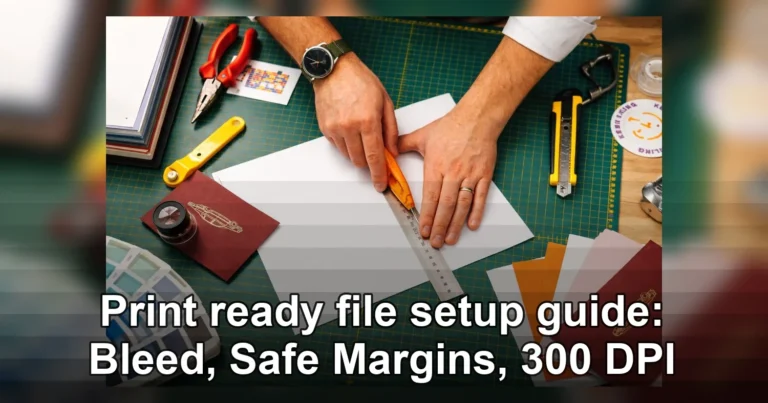
- Low-resolution images. Photos pulled from Instagram, Google, or screenshots often print soft or pixelated. For flyers, posters, and brochures, use images at 300 DPI at final size. A small web image stretched to 11×17 will usually fail.
- Missing bleed. If color or images run to the edge, add 0.125 inches of bleed on all sides. Without bleed, trimming can leave thin white edges.
- Wrong trim size. A file designed at 8.5×11 cannot simply be treated like 11×17 or 12×18 without layout problems. Set the document to the exact final size before exporting.
- Text too close to the edge. Keep logos, page numbers, and important copy inside a safe margin, usually at least 0.125 to 0.25 inches from the trim.
- Font problems. Missing fonts, unsupported fonts, or live text from design apps can reflow unexpectedly. Export a press-ready PDF and embed fonts, or convert them to outlines when appropriate.
Order and timing mistakes
- Submitting the wrong file version. Final-v2-revised-use-this.pdf errors happen all the time. Check the file name, page count, and date before sending.
- Approving proofs late. Even a same-day job can stall if proof approval comes in too close to pickup time.
- Ordering too late for finishing. Folding, booklet-making, trimming, lamination, and mounting all add production time.
A simple checklist helps: final trim size, bleed, safe margins, 300 DPI images, embedded fonts, correct quantity, and realistic submission timing.
Which option is best for students, student groups, and local businesses?
The best option depends on the job. For simple academic printing, campus printing is often enough. For branded, time-sensitive, or finish-heavy work, a nearby print shop is usually the better choice.
Best fit by scenario
- Quick class handouts and readings: Campus printing is usually the practical choice. If you need standard letter-size black-and-white or basic color for class use, it is built for routine student volume. Humber students already have access to academic printing services on campus, which makes straightforward coursework convenient.
- Student club event flyers: A nearby print shop is often better when you need 100 to 500 flyers, heavier paper, better color consistency, or trimmed stacks for tabling around North Campus.
- Posters for presentations, conferences, or recruitment: Choose the option that can reliably handle the final size you need. For 11×17 classroom posters, campus printing may work. For 18×24, 24×36, mounted posters, or cleaner color output, a nearby print shop is usually the safer bet.
- Business marketing materials: Local businesses should lean toward a nearby print shop for brochures, rack cards, menus, postcards, window signs, or branded handouts. These jobs often need better stock choices, finishing, and a more polished appearance.
- Last-minute same-day needs: If the file is simple and ready to print, campus printing can be fastest for students already on site. If the job needs cutting, folding, binding, or oversized output, a nearby shop may save the day if you call first.
Simple rule of thumb
Use campus printing for basic academic documents and short-run class materials. Use a nearby print shop when quality, format flexibility, finishing, or event presentation matters more than convenience alone.
Before you place an order, confirm four things first: your final file format, the exact quantity, the real deadline, and whether you need color accuracy, binding, trimming, or large-format output. If the job is a simple academic print and on-campus pickup works for you, campus printing may be the most efficient choice. If the piece represents your club, event, or business, a nearby print shop is often the safer option for quality control and finishing.
A practical next step is to match the job to the stakes: use campus printing for simple, ready-to-print documents, and request a quote from a nearby print shop for branded, time-sensitive, or higher-visibility materials. A quick file check and an early proof can save you from rush fees and last-minute reprints.
Helpful External Resources
These sources provide supporting background and additional context.
- Humber+College+ +North+Campus+Toronto+On
- Printing
- Academic Printing
Is campus printing usually cheaper than a nearby print shop near Humber College?
Campus printing is often cheaper for basic black-and-white pages and simple short runs, especially when you only need a few copies. A nearby print shop near Humber College can be better value for larger quantities, heavier paper, finishing, or urgent jobs that need faster turnaround and more flexible service.
What kinds of jobs are better suited to a nearby print shop than campus printing?
A nearby print shop is usually better for posters, flyers, booklets, business cards, presentation materials, mounted prints, and anything that needs trimming, folding, binding, or special paper. If you need polished results or custom specs, the best printing near Humber College is often a local shop rather than standard campus printing.
How far in advance should I plan printing for an event at Humber College?
For simple handouts, plan at least 1 to 2 days ahead. For larger orders, color pieces, or jobs with finishing, give yourself 3 to 5 business days if possible. If your event is close to campus and you need same-day or next-day service, check availability early and confirm pickup timing before placing the order.
What should I check before ordering the best printing near Humber College?
Confirm file format, bleed, resolution, paper size, color mode, and whether you need one-sided or double-sided printing. Also check turnaround time, proof approval, minimum quantities, pickup location, and any setup or finishing fees so there are no surprises.
Get a Free Quote Today
Contact us at +1-(416) 288-8661 or Email us at info@Brandingcentres.com and let's get started.