
The Parachute Effect: Why We Refuse Solid Vinyl for Windy Spots
Picture this: It is Monday morning. You are driving along the Gardiner Expressway after a heavy Sunday night storm. You look up at a construction site or a fence line, expecting to see a company’s branding. Instead, you see a tattered, shredded strip of plastic flapping helplessly in the breeze, held on by one surviving zip tie.
It looks cheap. It looks unprofessional. And worst of all, it was entirely preventable.
At Branding Centres, we often have to have difficult conversations with clients. They want the vibrancy of a solid 13oz vinyl banner, but they want to install it on a chain-link fence in an open field. We often refuse the job - not because we don't want the work, but because we understand physics. That shredded banner isn't a result of bad luck; it is a result of the Parachute Effect.
The Science: It’s Not a Sign, It’s a Sail
To a designer, a banner is a canvas. To an engineer, a banner is a sail.
When you take a standard 10ft x 10ft piece of solid vinyl and strap it to a fence, you are creating a 100-square-foot surface area with a high Drag Coefficient. Solid vinyl is non-permeable. It does not let air pass through it.
When a gust of wind hits that surface, the energy cannot dissipate. It converts into kinetic force. In a moderate 60km/h gust (common in Toronto), that banner can generate hundreds of pounds of force. That force has to go somewhere. Since the vinyl can't move, the energy transfers to the weakest points of resistance: the grommets and the hem.
The result? The grommets rip out of the vinyl like a button popping off a tight shirt, sending your investment flying into traffic.
The Solution: Mesh Vinyl Engineering
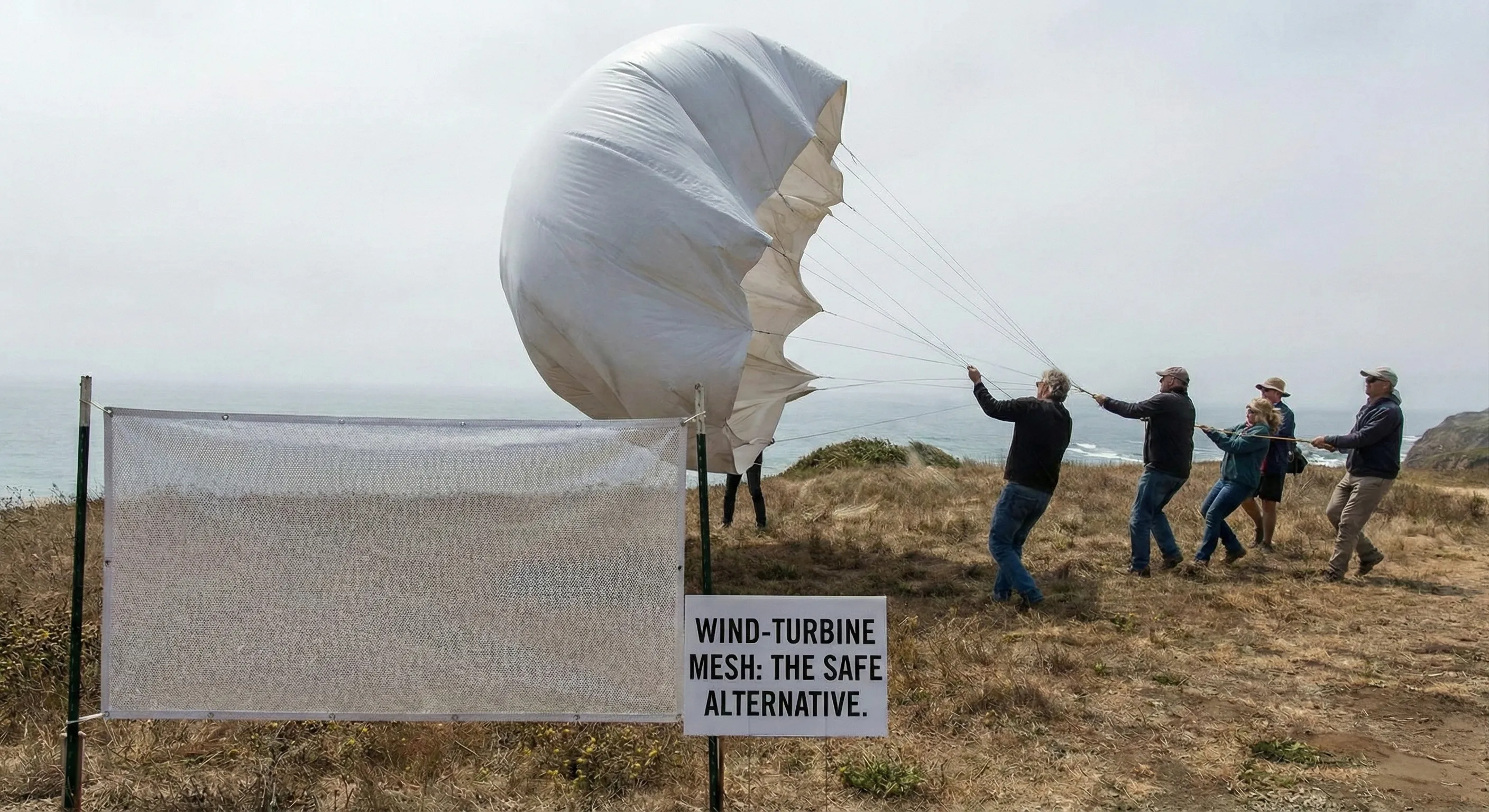
The antidote to the Parachute Effect is Mesh Vinyl.
Unlike solid scrim vinyl, Mesh is engineered with a specific weave pattern - typically 70/30 (70% material, 30% airflow) or 50/50. It looks solid from a distance, but up close, it is perforated with thousands of tiny holes.
These perforations change the physics of the sign. Instead of blocking the wind, the material allows the air to pass through it. This significantly reduces the Wind Load on the structure. By reducing the surface resistance, we can reduce the force exerted on the grommets by approximately 35% to 40%. This ensures the banner stays taut, legible, and secure, even during a GTA storm.
The Simulator: Visualizing Wind Load
We can talk about drag coefficients all day, but seeing is believing. We have modeled the physics of solid vs. mesh materials to show you exactly what happens when the wind speed picks up.
Don't believe the math? we built a simulator to prove it.
CYBERWIND
Did you see that? At 100km/h, the Vinyl snaps. The Mesh stays secure. That is the difference between a long-lasting sign and a liability claim.
Local Context: The Toronto Tunnel Effect
Why is this so critical for businesses in the GTA? Because Toronto is architecturally designed to accelerate wind.
We deal with two specific environments that destroy solid banners:
1. The Condo Canyons: In downtown Toronto, the tall skyscrapers create a "Venturi Effect," channeling wind into narrow streets and increasing its velocity. A banner mounted near a high-rise construction site is subjected to wind speeds far higher than the weather forecast suggests.
2. The Open Fields: In industrial areas like Etobicoke or Vaughan, large open parking lots and fields provide zero windbreak. A fence banner here takes the full, uninterrupted force of the wind.
If you are installing signage in these zones, solid vinyl is a ticking time bomb.
Conclusion: Engineering Over Aesthetics
While solid vinyl offers slightly higher print resolution, the trade-off is durability. A vibrant sign that is ripped in half is worth zero impressions. By choosing Reinforced Mesh Banners, you are choosing longevity and safety.
Stop guessing. Use the simulator above to check your risk, then call Branding Centres to get a quote on Reinforced Mesh Banners that can handle the Canadian winter.
Contact ustoday at info@brandingcentres.com or call us at +1-(416) 288-8661 to discuss which paper stock is right for your brand vision.
Frequently Asked Questions (FAQs)
1. Does mesh vinyl look as good as solid vinyl?
Mesh vinyl has a slightly more muted appearance because 30% of the surface area is empty space (holes). However, from a viewing distance of 10 feet or more, the human eye fills in the gaps, and the graphics look solid and readable.
2. Can I just cut wind slits in a solid banner?
We do not recommend this. Cutting "wind slits" or half-moons into a solid banner compromises the structural integrity of the material. These slits often become the starting point for tears that rip across the entire banner during a storm. Mesh is a superior, purpose-built solution.
3. How long do mesh banners last outdoors?
With proper installation (using all grommets and proper tension), a high-quality mesh banner can last 2 to 3 years outdoors. UV-resistant inks help prevent fading, but the material itself is built for the elements.
4. Do mesh banners require special finishing?
Yes. Because mesh is lighter, we reinforce the edges with heat-welded webbing (a seatbelt-like material) before inserting the grommets. This ensures the grommets have something substantial to grip, preventing them from tearing out under tension.
5. What is the best method to hang a mesh banner on a fence?
Use heavy-duty zip ties or bungee cords through every grommet. Never skip grommets. Skipping grommets creates uneven tension points where the wind can concentrate its force, leading to tears.