
Graffiti Proof Signs: The $50 Upgrade That Saves Thousands
As the Lead Material Scientist at Branding Centres, I look at signage differently than a graphic designer does. They look at colours, typography, and layout. I look at molecular bonds, polymer cross-linking, and ultraviolet degradation.
I also look at your bank account.
Nothing frustrates me more than seeing a Toronto business owner invest $400 in a beautiful new storefront sign, only to have it ruined three weeks later by a single vandal with a $5 can of spray paint. It is a waste of materials, it is a waste of labour, and for you, it is a waste of capital.
You might think that "vinyl is vinyl." You might assume that a standard laminate is enough protection. The physics of polymers tells a different story. Standard vinyl is porous. It absorbs threats. To protect your investment in the harsh urban environment of the GTA, you need a barrier that is chemically engineered to reject them.
We call this the $50 Shield. It is the upgrade to Premium Anti-Graffiti Laminate. Here is the science behind why it is the only financially sound choice for outdoor Custom Vinyl Graphics.
The "Porosity" Problem: Why Standard Signs Die Young
To the naked eye, a standard "Gloss" or "Matte" vinyl finish looks like a solid, impermeable sheet of plastic. Under a microscope, however, standard PVC (Polyvinyl Chloride) tells a different story.
The Microscopic Sponge
Standard calendared or cast vinyl is microscopically porous. It has a surface texture filled with peaks and valleys invisible to the human eye. When a vandal tags your sign with spray paint or a permanent Sharpie marker, the pigment does not just sit on top of the surface. The solvents in the paint act as a carrier, dragging the pigment deep into those microscopic pores.
The paint literally bonds with the plastic of your sign.
The Solvent Trap
This is where the nightmare begins for the business owner. You see the graffiti, and you grab a bottle of acetone, rubbing alcohol, or a heavy-duty graffiti remover.
Here is the chemical reality: The solvents required to dissolve the spray paint are chemically similar to the solvents used to manufacture the vinyl itself.
• The Action: You scrub the sign with the solvent.
• The Reaction: The solvent dissolves the paint, but it also attacks the vinyl laminate. It melts the surface, turning your crisp, high-resolution print into a cloudy, smeared mess.
The Result: You ruin the sign trying to save it. You are now forced to reprint and reinstall the entire graphic.
The "Glass Armor" Solution: The Science of Protection
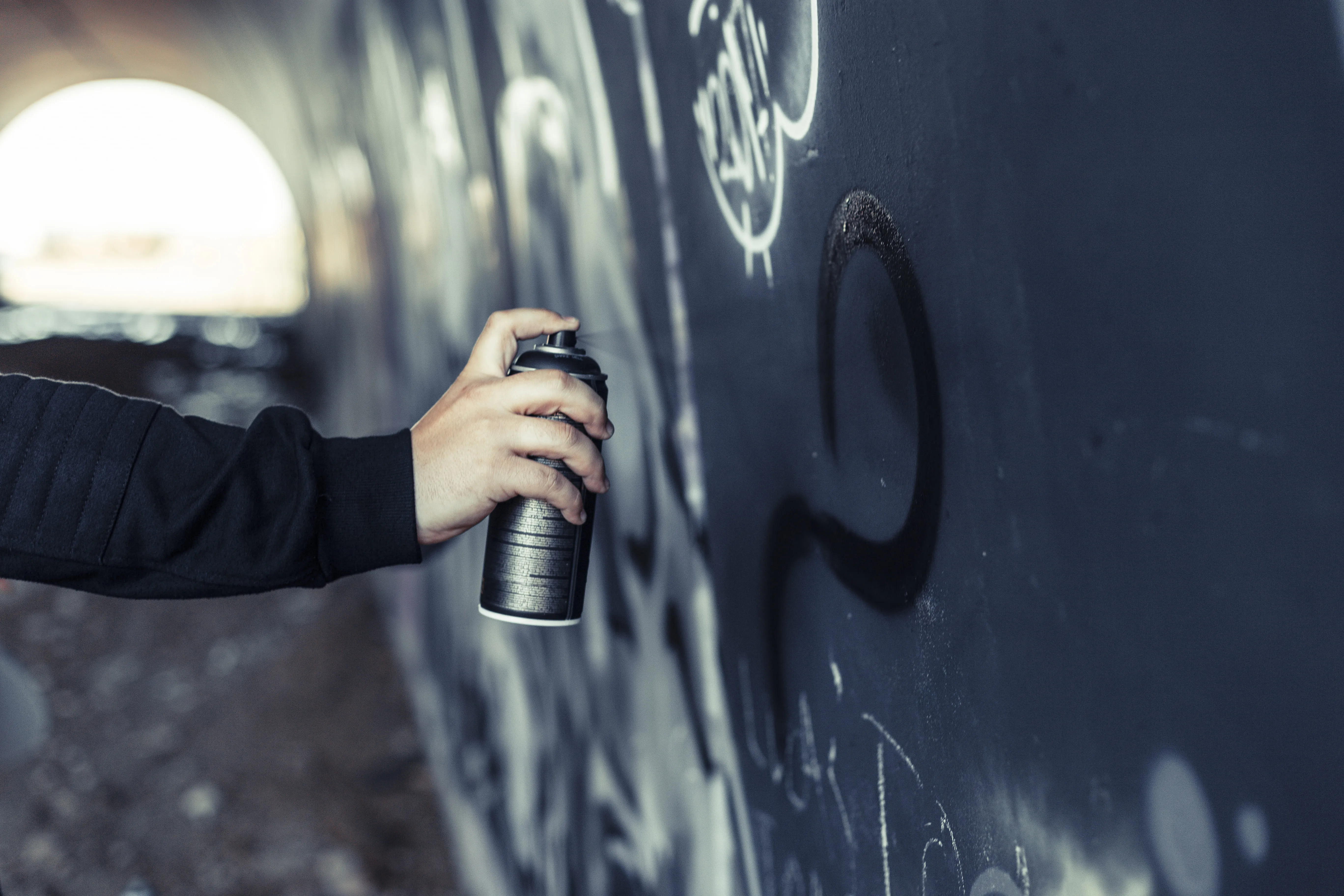
There is a way to cheat this system. It involves changing the surface energy of the sign so that nothing can bond to it. This is where Signage Protection Film (Anti-Graffiti Laminate) comes in.
Cross-Linked Polymers
Unlike standard vinyl, Anti-Graffiti laminate is engineered with a specialized layer of polyester or fluoropolymer. In simple terms, the molecules in this layer are "cross-linked" so tightly that they create an impenetrable barrier.
Think of it as turning your sign into a non-stick frying pan.
When graffiti hits this surface, the pigment cannot find a pore to settle into. It sits on top of the laminate, floating on the surface tension. It never bonds.
The Citrus Wipe
Because the paint hasn't bonded, you don't need harsh chemicals to remove it. You can often wipe away spray paint with a simple citrus-based cleaner or even a mild alcohol solution.
• The Benefit: The cleaner dissolves the paint but is not strong enough to penetrate the cross-linked shield of the laminate.
• The Outcome: You wipe away the vandalism in seconds. The print underneath remains pristine, glossy, and untouched.
The "Solar Burn": The UV Factor
Vandals are not the only threat to your signage. In Toronto, we deal with a silent killer that works every single day the sun is shining: Ultraviolet (UV) Radiation.
Even if your sign is never tagged, a standard laminate is often a poor investment for long-term Outdoor Sign Durability.
The Physics of Fading
UV rays are high-energy photons. When they hit the ink on your sign, they break the chemical bonds of the pigment.
• Red and Yellow Inks: These have the weakest chemical bonds. Without protection, they are the first to vanish.
• The Timeline: A standard sign without UV protection will start to show significant fading in 18 to 24 months. Your vibrant red logo turns pink. Your bright yellow background turns white.
The "SPF 50" Upgrade
Premium Anti-Graffiti Laminate doesn't just block paint; it blocks light. It acts like SPF 50 sunscreen for your brand. High-quality laminates contain UV inhibitors and light stabilizers that absorb or reflect the harmful UV radiation before it can reach the ink layers beneath.
By upgrading to this material, you are extending the effective visual life of your outdoor advertising sign from 2 years to 5–7 years.
The Interactive Proof: The Physics Lab
I know salesmen exaggerate. They will tell you anything to get an upsell. That is why I built this Physics Lab. I want you to try to destroy this virtual sign yourself.
Use the tool below to simulate a graffiti attack on both a Standard Laminate and our Premium Anti-Graffiti Laminate. Try to clean it. See what happens to the substrate.
SURFACELAB
LIQUID PHYSICS EDITIONCENTRES
CENTRES
Spray paint, then try to scrub it off.
Notice the difference? On the cheap side, the paint smeared, and the graphic cracked under the stress of the cleaning agents. The ink was destroyed. On the premium side, the gloss reflection stayed perfect. The paint wiped away without ghosting.
This isn't magic. It is material science.
The ROI Math: Why Cheap is Expensive
Let's move away from chemistry and look at the economics. Many business owners hesitate at the "Upsell" for premium laminate. They see it as an extra cost. I see it as insurance.
Here is the breakdown for a standard 4ft x 8ft storefront sign.
Scenario A: The "Budget" Choice
You choose the standard laminate to save money.
• Initial Cost: $400.
• Incident: Six months later, the sign is tagged.
• Action: You try to clean it, ruining the finish. You must replace the sign.
• Replacement Cost: 400 + Installation Labor (150).
• Total Year 1 Cost: $950.
Scenario B: The "Smart" Choice
You upgrade to Graffiti Proof Signs Toronto standards.
• Initial Cost: $450 (The $50 premium).
• Incident: Six months later, the sign is tagged.
• Action: You wipe it off with a rag and cleaning spray.
• Cleaning Cost: $0.50.
• Total Year 1 Cost: $450.50.
The Verdict
The "expensive" sign saved you $499.50 in the first year alone. This calculation does not even include the value of the extended lifespan (7 years vs. 2 years) due to UV protection.
Conclusion: Protect Your Assets
Your signage is often the first interaction a customer has with your business. A faded, peeling, or graffiti-covered sign sends a message of neglect. A crisp, glossy, pristine sign sends a message of professionalism and stability.
At Branding Centres, located in Etobicoke and serving the entire GTA, we believe in engineering solutions that last. We don't want to sell you two cheap signs; we want to sell you one perfect sign that lasts a decade.
Don't let a $50 decision cost you thousands in the long run. Upgrade your armor.
Ready to bulletproof your branding?Contact Branding Centres today at info@brandingcentres.com or call us at +1-(416) 288-8661 to discuss your signage needs.
Frequently Asked Questions (FAQs)
1. Does anti-graffiti laminate change the look of the sign?
No. High-quality anti-graffiti laminates are optically clear. They are available in high-gloss finishes that actually enhance the vibrancy of the colors beneath, making the sign look like it is behind glass.
2. Can I apply anti-graffiti laminate to my existing sign?
It is difficult to apply laminate to a sign that is already installed and weathered. The dirt and oxidation on the old sign will prevent a proper bond. It is highly recommended to apply the laminate during the initial production phase for a permanent seal.
3. Is anti-graffiti laminate just for graffiti?
No. It is primarily an industrial-grade protection film. It protects against harsh weather, bird droppings, road salts (if near a highway), and abrasion from tree branches. It is the ultimate shield for Signage Protection Film.
4. How long does the graffiti protection last?
The cross-linked surface is extremely durable. You can clean it dozens of times without degrading the protective qualities. Typically, the film will last 5 to 7 years outdoors before the UV inhibitors begin to break down.
5. Is this the same as the "ceramic coating" used on cars?
The concept is similar (creating a hydrophobic, non-stick surface), but the application is different. Ceramic coating is a liquid applied to paint. Anti-graffiti laminate is a physical layer of plastic film bonded to the print. The film offers superior impact resistance compared to a liquid coating.