
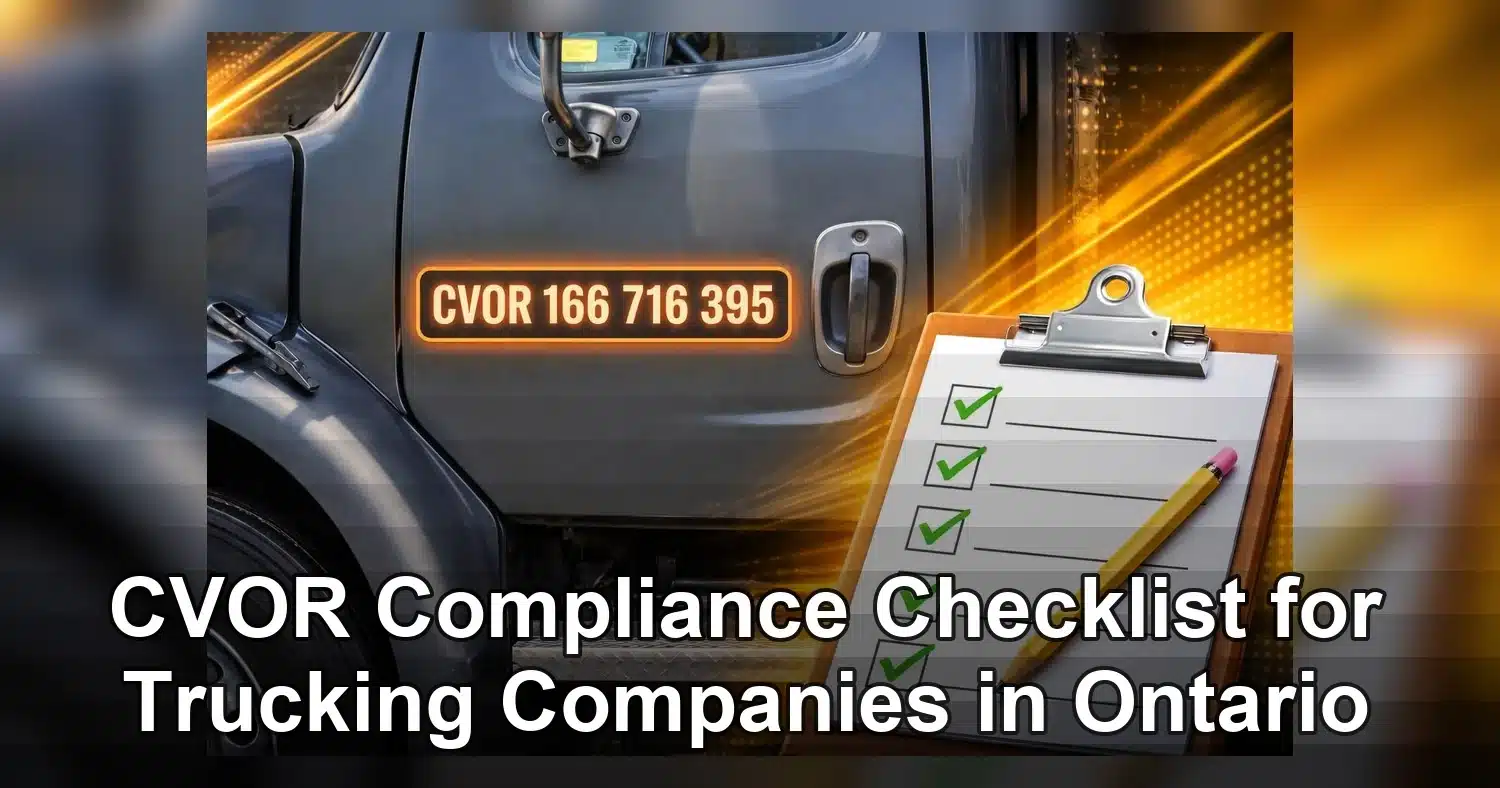
CVOR Compliance is a critical part of running a trucking company in Ontario because it affects your legal authority to operate, your safety rating, and your ability to avoid costly penalties. If you own or manage a fleet, understanding the Commercial Vehicle Operator’s Registration system can help you keep vehicles, drivers, and paperwork in order from day one. For a practical overview of decals and placement, see our guide on CVOR number commercial vehicle decals in Ontario.
Last updated: March 2026
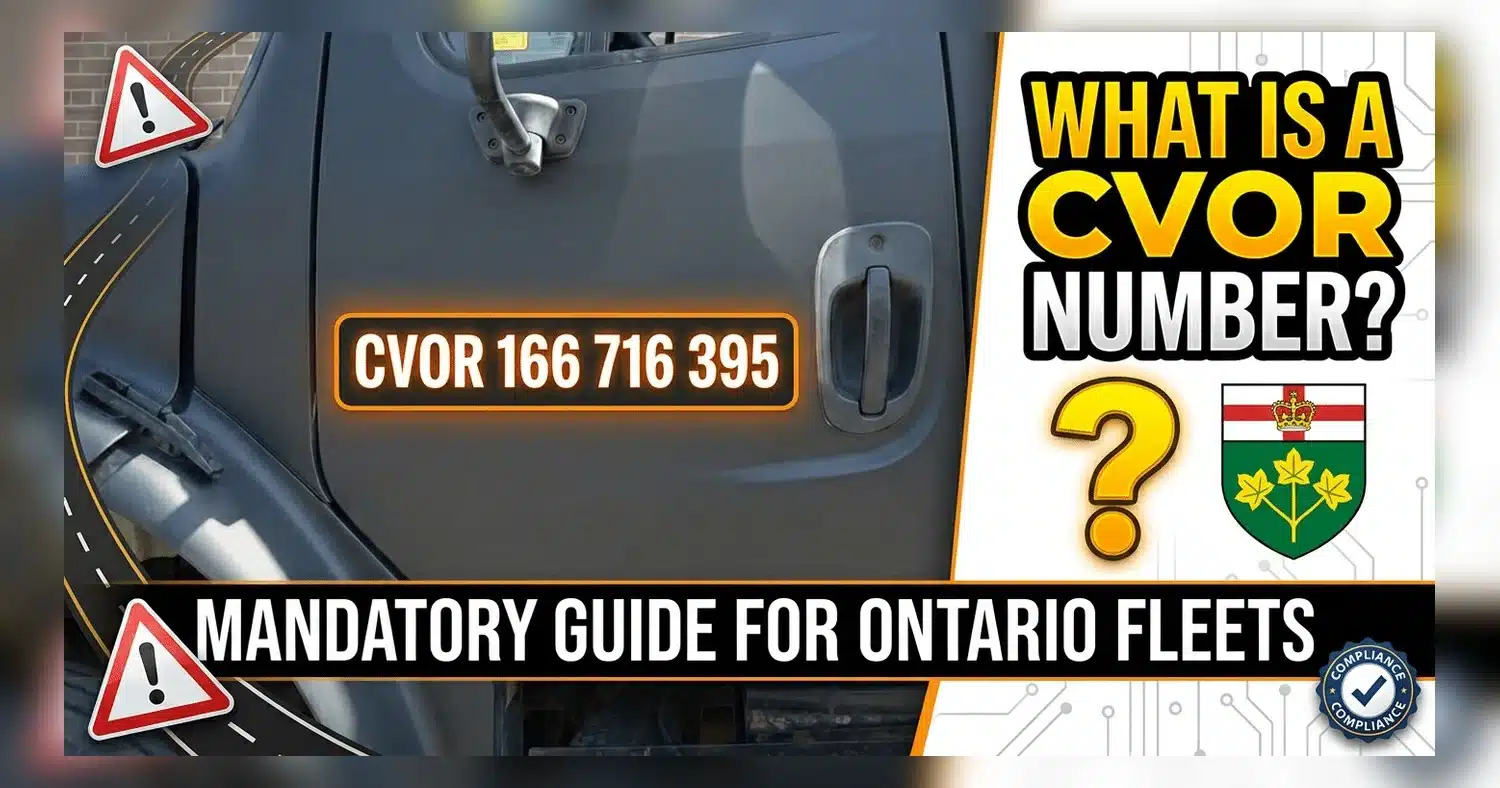
This checklist is designed for business owners who want a clear, operational view of what compliance involves, from registration and recordkeeping to audits and inspections. Ontario’s requirements also work alongside broader safety expectations, including national standards often discussed in trucking compliance resources such as this overview of CVOR and NSC services for trucking businesses. Use the sections below to build a stronger compliance process and reduce avoidable risk.
What is CVOR and who needs a CVOR Number in Ontario?
CVOR stands for Commercial Vehicle Operator’s Registration. It is Ontario’s system for tracking the safety performance of commercial carriers that operate on public roads. The goal of CVOR compliance is to make sure trucking companies, fleets, and other commercial operators meet safety, maintenance, and recordkeeping expectations while running vehicles in the province.
In Ontario, an operator is the person or business responsible for the operation of the commercial vehicle, while the owner is the legal owner of the vehicle itself. These may be the same company, but not always. If your business directs the use of commercial vehicles, manages drivers, or controls the day-to-day operation of the fleet, you may be considered the operator even if another party owns the equipment.
A CVOR Number is generally required for businesses that operate commercial vehicles with a gross weight or registered gross weight over 4,500 kg, as well as buses and certain other regulated vehicles. This includes many trucking companies, delivery fleets, and businesses using vehicles for commercial purposes. If your vehicles cross provincial or international borders, the CVOR framework is still part of your Ontario compliance obligations when operating in the province.
For a deeper breakdown of who must register, the Province of Ontario’s commercial vehicle operators registration page explains the basic registration requirement and who is considered an operator.
Some businesses assume CVOR only applies to large carriers, but the requirement is based on vehicle type, weight, and how the vehicle is used. If you own or manage commercial vehicles in Ontario, it is worth confirming whether your company needs a CVOR Number before putting the vehicle into service.
CVOR Compliance Requirements for Ontario Trucking Companies
Ontario trucking companies have several core CVOR compliance duties. The first is maintaining an active CVOR registration for the business operating the fleet. If company details change, such as ownership, address, or legal name, the record should be updated promptly so the registration stays accurate.
Commercial vehicles that require CVOR identification must display the CVOR Number properly. This is part of making the vehicle easy to identify during roadside checks and inspections. Many fleets also rely on properly produced CVOR number commercial vehicle decals in Ontario to meet visibility and placement expectations.
Vehicle maintenance is another major requirement. Trucking companies must keep commercial vehicles in safe operating condition through regular inspections, repairs, and documented maintenance procedures. Brake checks, tires, lights, steering components, and other safety-related items should be monitored on a schedule that matches the vehicle’s use.
Driver qualifications matter as well. Ontario businesses must ensure drivers hold the right licence class, have the proper endorsements where needed, and are fit to operate the vehicle assigned to them. Companies should also verify hours of service compliance, safety training, and suspension history where appropriate.
CVOR compliance also connects with National Safety Code, or NSC, expectations for carrier safety management. Ontario trucking companies should align their policies, training, and records with NSC standards so their safety program supports audits, inspections, and overall fleet accountability. That alignment helps reduce risk and keeps the business prepared for enforcement reviews.
Step-by-Step Checklist: Registration, Decals, and Operating Authority
-
Confirm whether your fleet needs CVOR registration. Review your vehicle weights, vehicle type, and commercial use to determine if the business must register before operating in Ontario.
-
Gather your business and vehicle details. Prepare legal business name, operating address, owner information, vehicle list, and any supporting documents needed for registration.
-
Apply for the CVOR Number. Submit the registration through the appropriate Ontario process and keep the approval documents in your compliance file once issued.
-
Order the correct decals or numbering materials. Use compliant CVOR number decals that match your fleet’s vehicle identification needs and are sized for clear visibility.
-
Place the CVOR Number correctly. Install the identification where it is easy to see on the vehicle exterior and ensure the number remains legible after washing, weather exposure, and daily use.
-
Verify operating authority and permits. Confirm whether the business needs additional permits, provincial authority, or trip-specific documentation before dispatching trucks.
-
Check insurance, maintenance, and driver files. Make sure each vehicle has the right documents, current insurance, and a completed driver qualification file before it enters service.
It also helps to review whether your decal format and printing match Ontario expectations. Many fleets use the CVOR number printing requirements in Ontario as a final check before installation so the identifier is readable and professionally produced.
Recordkeeping and Electronic Log Requirements (ELD and Paper Logs)
Strong recordkeeping is a key part of CVOR compliance for Ontario trucking companies. Fleets should maintain organized files for vehicle inspections, maintenance reports, driver records, accident documentation, permits, and any other records that may be requested during an inspection or audit.
Drivers are expected to complete daily log records when required by hours-of-service rules. If a driver is using an electronic logging device, the ELD must capture drive time, on-duty time, off-duty time, and related status changes accurately. If paper logs are permitted in a specific situation, they must still be filled out clearly and kept up to date throughout the day.
In practice, the company should keep documentation that supports every trip and every vehicle assignment. That includes pre-trip and post-trip inspection reports, repair orders, annual inspection certificates, driver licence and abstract records, training documents, and trip records. These files help prove the fleet is being managed responsibly.
Retention periods matter. Businesses should keep logs and supporting documents long enough to satisfy audit, investigation, and inspection requirements. A well-organized retention system makes it easier to respond if officers request records after a roadside stop or if the company is reviewed for safety performance.
For fleets modernizing their compliance process, ELD use should be paired with clear internal procedures so drivers know when to log, how to correct errors, and where to store backup records if equipment fails. Keeping both digital and paper support files reduces gaps and makes CVOR compliance easier to defend.
Driver Training, Policies, and Accountability
Strong CVOR Compliance starts with clear driver rules and consistent training. Trucking Companies should document who is allowed to operate each commercial vehicle, what qualifies as a safe trip, and what steps drivers must follow before, during, and after a run. Policies should cover hours of service, load security, speed management, distracted driving, defect reporting, and collision reporting.
Training should not be a one-time event. Build an onboarding program for new drivers, then add refresher sessions for seasonal changes, new equipment, incident trends, and policy updates. Drivers should understand how CVOR-related records are created, who reviews them, and why accurate documentation matters. That includes logbooks, vehicle condition reports, maintenance files, and driver discipline records.
Pre-trip inspections and documentation
Require a documented pre-trip inspection before every dispatch. Drivers should confirm brakes, tires, lights, coupling devices, mirrors, signals, cargo securement, and warning devices. Any defect must be reported immediately and corrected before the vehicle returns to service when required. Keep signed inspection records organized and easy to retrieve during an audit or roadside review.
Employers should also define accountability clearly. Assign responsibility for reviewing inspection reports, coaching drivers, tracking repeat defects, and escalating serious violations. Supervisors should verify that the driver holds the proper license class, medical fitness, and training for the vehicle and route assigned.
For fleets that display commercial markings, make sure vehicle identification and decal placement stay consistent with your records. A reliable CVOR number commercial vehicle decals Ontario process helps reduce confusion when vehicles are inspected.
Finally, maintain proof that the company is actively monitoring compliance. Written policies, attendance logs, inspection checklists, and corrective actions show that safety is managed, not assumed.
Common Violations, Penalties, and How to Avoid Them
Most CVOR issues come from preventable gaps in supervision, maintenance, and recordkeeping. Repeated problems can lead to warnings, audits, higher enforcement scrutiny, CVOR sanctions, and in serious cases suspension of operating privileges. The best defense is a routine internal review that catches issues before the Ministry does.
| Violation | Typical consequence | Prevention action |
|---|---|---|
| Missing or incomplete logbooks / ELD records | Inspection defects, fines, audit findings | Review logs daily and reconcile exceptions weekly |
| Unreported collisions or late reporting | CVOR record issues, enforcement attention, penalties | Use a written incident reporting process with same-day escalation |
| Poor vehicle maintenance records | Audit deficiencies, out-of-service events | Track repairs, inspections, and defect corrections in one system |
| Defective brakes, tires, lights, or securement | Roadside out-of-service orders, safety risk, fines | Enforce pre-trip checks and remove unsafe units immediately |
| Driver training gaps or unauthorized operators | Compliance findings and increased liability | Verify licensing, training, and authorization before dispatch |
Owners can reduce risk by scheduling recurring file audits, coaching drivers on repeat mistakes, and tying dispatch approval to completed paperwork. If your fleet uses decals or identification labels, keep them accurate and visible. A proper CVOR number decal helps maintain professional presentation and consistent vehicle identification.
Preparing for Audits, Inspections, and Incident Response
When a Ministry audit or roadside inspection happens, preparation matters. Keep your records organized by vehicle and driver so they can be produced quickly. Inspectors may review collision history, maintenance files, inspection reports, logbooks, trip records, training documentation, and proof that defects were corrected. If the company cannot locate records promptly, that can become a compliance issue on its own.
What to have ready
- Driver qualification files
- Current vehicle inspections and defect repair records
- Trip logs, ELD data, and supporting documents
- Collision and incident reports
- Maintenance schedules and work orders
- Company policies and training records
During roadside stops, drivers should remain professional, provide requested documents, and avoid guessing if they do not know an answer. If an officer identifies a defect or violation, the driver should note exactly what was said, who was involved, and whether the vehicle was allowed to continue. That information should be sent to management right away.
After an incident, respond fast. Remove unsafe equipment from service, document the facts, preserve photos and witness details, notify management, and correct the root cause. If there is an enforcement issue, review whether the problem is isolated or part of a broader process failure. Repeated findings often point to a weak policy, a training gap, or poor supervision.
For a broader view of registration and operator requirements, keep a copy of the Ontario commercial vehicle operators registration CVOR page in your compliance file so your team can reference the current framework.
Maintaining and Improving Your Safety Rating: Best Practices and Next Steps
A strong safety rating is earned through consistency. Monitor your CVOR performance every month, not just when renewal time arrives. Review collisions, convictions, inspections, and maintenance trends so you can spot repeat issues early. If one driver, route, or vehicle is creating most of the exposure, address it before it affects the whole fleet.
Best practices for ongoing CVOR Compliance
- Run monthly internal audits of logs, defects, and maintenance files
- Coach drivers using real examples from inspections and incidents
- Track corrective actions until closure
- Update policies when regulations, equipment, or routes change
- Keep decal and operator identification records consistent
Businesses should also maintain a clear calendar for renewals, training refreshers, and vehicle record updates. If the company is growing, adding routes, or expanding into new operating categories, it may be time to bring in a compliance consultant. Legal counsel can also help if you are facing a serious audit, contested penalty, collision investigation, or a possible rating impact.
For operators who need help keeping vehicles properly identified, use a trusted CVOR number printing requirements Ontario resource to stay consistent across the fleet. You can also review your broader operator responsibilities through the CVOR number for commercial vehicle operators guide.
Next steps should be practical: review your scorecard, correct repeat defects, train supervisors, and tighten documentation before the next audit or inspection cycle. A disciplined process keeps your fleet safer and your compliance position stronger.
Strong CVOR compliance comes down to consistent processes, accurate records, and active fleet oversight. If you keep registrations current, train drivers well, and review violations early, you will be in a much better position to protect your safety rating and business reputation.
If you need help with CVOR decals or want support keeping your fleet organized, explore our CVOR number decal options and take the next step toward easier compliance.
Related Products and Services
If you are planning a similar project, these related options may help.
Helpful External Resources
These sources provide supporting background and additional context.
What is a CVOR Number and how do I get one for my trucking company?
A CVOR Number is Ontario’s Commercial Vehicle Operator’s Registration, issued to companies that operate commercial vehicles. To get one, you must apply through the Ontario Ministry of Transportation, provide company and fleet details, and meet the registration requirements for your operation. Once issued, the CVOR must be kept active and tied to your safety and compliance responsibilities.
What records must I keep to remain CVOR compliant in Ontario and for how long?
To support CVOR Compliance, keep records such as driver files, hours of service, vehicle maintenance and inspection reports, accident records, trip inspections, training documents, and conviction or violation notices. In Ontario, many of these records should be retained for at least 12 months, and some safety and vehicle records may need to be kept longer depending on the document type and regulatory requirement.
How do ELD requirements affect CVOR compliance for commercial drivers?
Electronic Logging Device requirements affect CVOR Compliance because ELDs help track hours of service accurately and reduce logbook violations. For commercial drivers, using compliant ELDs supports proper recordkeeping, helps prevent fatigue-related offenses, and can lower the risk of penalties that may affect your carrier safety profile.
What happens if my company receives a poor CVOR safety rating or is fined?
A poor CVOR safety rating can lead to increased enforcement scrutiny, audits, and possible restrictions on your operations. Fines and violations can also raise your carrier safety score and affect your ability to keep insurance, win contracts, or pass compliance reviews. Corrective action, training, and stronger maintenance and driver controls are important to improve your standing.
What are the main items on a CVOR Compliance Checklist for trucking companies?
A basic CVOR Compliance Checklist should include valid registrations and permits, daily vehicle inspections, maintenance scheduling, driver abstracts and training, hours of service monitoring, collision reporting, and prompt response to violations or defect reports. Reviewing these items regularly helps reduce risk and keep your trucking company compliant in Ontario.
Get a Free Quote Today
Contact us at +1-(416) 288-8661 or Email us at info@Brandingcentres.com and let's get started.